
Blog
DUTCH SAILOR FORCED TO ABANDON YACHT IN 2022 ARC EMERGENCY HIGHLIGHTS LIFESAVING EPIRB

Innovation in safety technology is rarely about a single leap forward. More often, it is the result of persistence over many years—of listening to users, navigating regulatory complexity, and pushing engineering boundaries until something once considered impossible becomes indispensable. That is exactly the story behind Ocean Signal’s rescueME PLB3 AIS Personal Locator Beacon, recognised with the prestigious King’s Award for Enterprise in Innovation 2026.
The PLB3’s success is not defined by a single accolade, but by an exceptional sequence of honours that underline its impact on the marine safety industry and the global maritime community. It was named Overall Winner at the 2022 METSTRADE DAME Design Awards—widely regarded as the most prestigious design competition in the marine sector—having already secured the Innovation category. To then go on to receive the King’s Award for Enterprise in Innovation, representing the pinnacle of British business achievement, places the PLB3 in an exclusive group of products. Securing recognition across both of these industry-led and globally respected awards is a rare distinction, reflecting not only technical excellence but meaningful, real-world advancement in safety.
The idea behind the rescueME PLB3 was deceptively simple: combine the global Search and Rescue alerting power of a Personal Locator Beacon (PLB) with the local tracking precision of an AIS Man Overboard (MOB) device. For years, customers had been asking for a single unit that could do both.
But simplicity in concept did not translate to simplicity in execution.
PLBs operating on 406 MHz and 121.5 MHz are tightly regulated, leaving little room for modification. At the same time, AIS MOB devices had already proven their value for localised rescue scenarios. Bridging the two technologies into one compact, wearable unit posed both regulatory and engineering challenges—particularly around size, power consumption, and usability.
The question was not just whether it could be done, but whether it could be done without compromise.
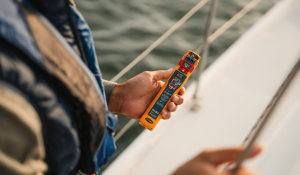
From the outset, the design philosophy was clear: the PLB3 had to be small enough to be worn at all times. A device left behind is a device that cannot save a life.
Drawing on earlier insights from lifejacket integration challenges, the team adopted a long, slim form factor—one that could fit seamlessly into modern, low-profile inflatable lifejackets. Achieving this while incorporating dual-frequency PLB functionality and AIS transmission required a fundamental rethink of internal architecture.
Ocean Signal’s engineers pushed beyond already miniaturised components, adopting even smaller technologies typically reserved for advanced mobile devices. At the same time, they rigorously tested battery capacity to ensure the unit could meet—and exceed—operational requirements without increasing bulk.
The result is a device that delivers multiple life-saving technologies in a remarkably compact form.
Rather than stopping at regulatory requirements, the Ocean Signal team addressed the critical issue of how the PLB3 could be more useful in everyday scenarios—not just emergencies.
One standout solution was the integration of Near Field Communication (NFC). Unlike Bluetooth or Wi-Fi, which would draw power from the beacon’s battery, NFC allows users to interact with the device via a smartphone without consuming onboard energy. By simply tapping their phone, users can access test data, check registration status, and become more familiar with the device.
This seemingly small addition solves the significant real-world problem of many users hesitating to test emergency beacons for fear of triggering false alerts. As a result, devices can go untested and even unregistered—factors that can delay rescue operations.
By making interaction intuitive and risk-free, the PLB3 encourages regular engagement, ultimately improving safety outcomes.
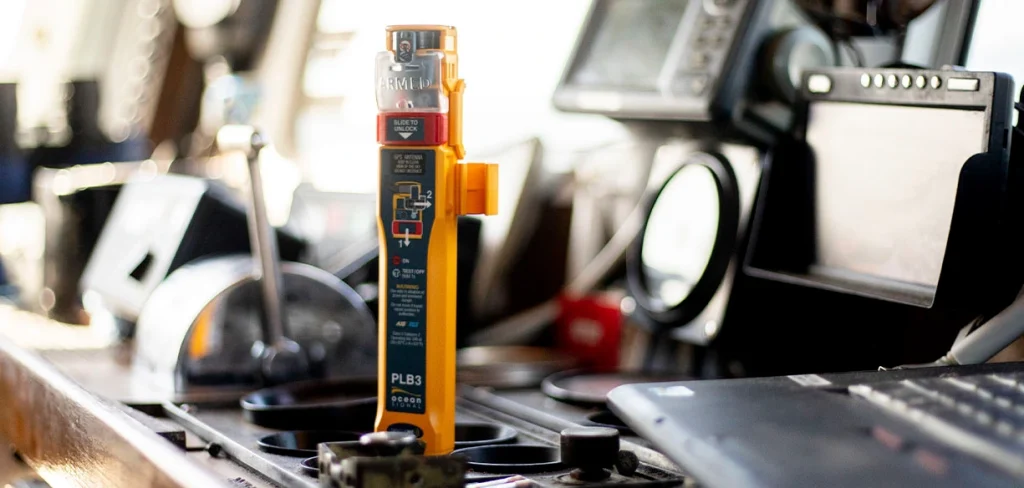
Every aspect of the PLB3’s design reflects its core purpose — to save lives under the most challenging conditions.
The semi-automatic activation system ensures the beacon deploys when needed, triggered by lifejacket inflation. The interface is deliberately simple, with clear visual indicators that can be understood even in high-stress, low-visibility situations.
Gaining approval for a device that combines multiple transmission technologies is no small feat. Each added feature must be proven not to interfere with the beacon’s primary life-saving function.
For the rescueME PLB3, this meant extensive testing—particularly around battery performance and the integration of NFC. The Ocean Signal team worked closely with approval bodies to demonstrate that every innovation upheld the highest standards of reliability.
This rigorous process underscores a key principle: innovation in safety equipment is only meaningful if it maintains absolute trust.
The impact of the PLB3 extends beyond a single product. Its development has laid the groundwork for a new generation of emergency beacons, influencing the design and capabilities of subsequent devices across the range.
By tackling the most challenging constraints first—size, integration, and power—the team has created a scalable platform for future innovation.
The King’s Award for Enterprise in Innovation celebrates more than technical achievement; it recognises the companies and solutions that make a tangible difference in people’s lives.
Ocean Signal and the PLB3 embody that mission.
For our dedicated team, the King’s Award honour gives us all tremendous pride and inspiration to continue with our mission to save more lives. It also represents a significant milestone in the company’s exceptional journey from its founding in 2010 to our position today as one of the world’s leading innovators in our field.
For the PLB3, the Kings Award marks a convergence of user insight, engineering excellence, and an unwavering commitment to safety. Every design decision, every test, and every iteration was guided by a single question: will this help save a life when it matters most?
That focus is what transforms innovation from an idea into an impact—and what makes the PLB3 a truly deserving recipient of one of the industry’s highest honours.