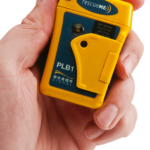
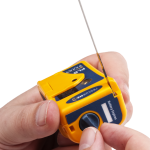
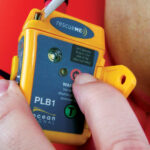
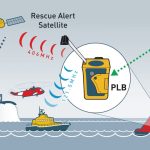
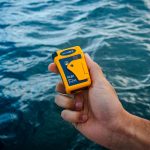
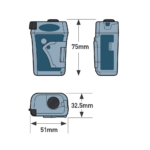
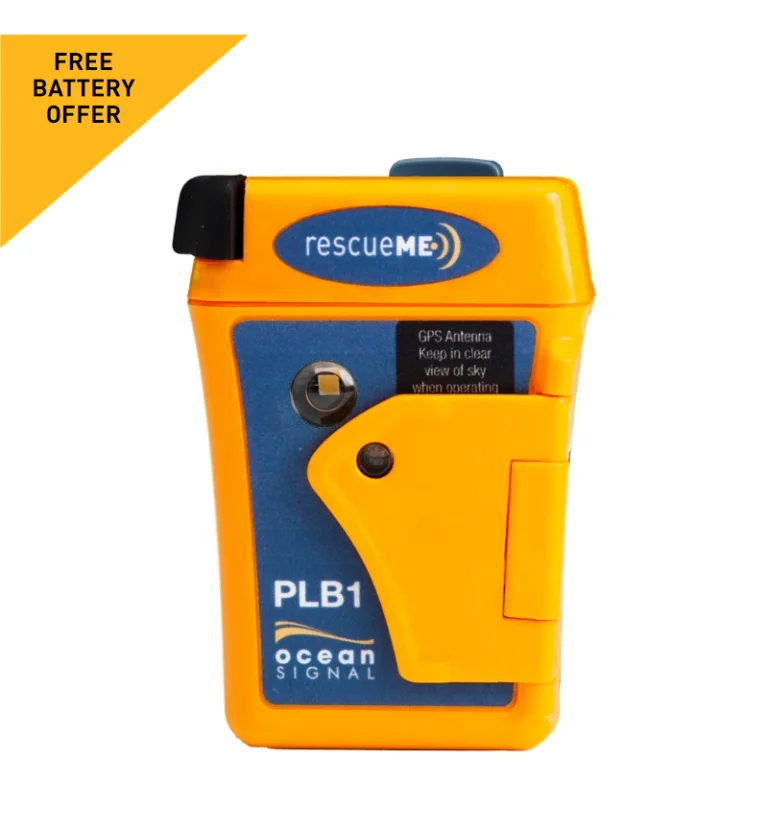
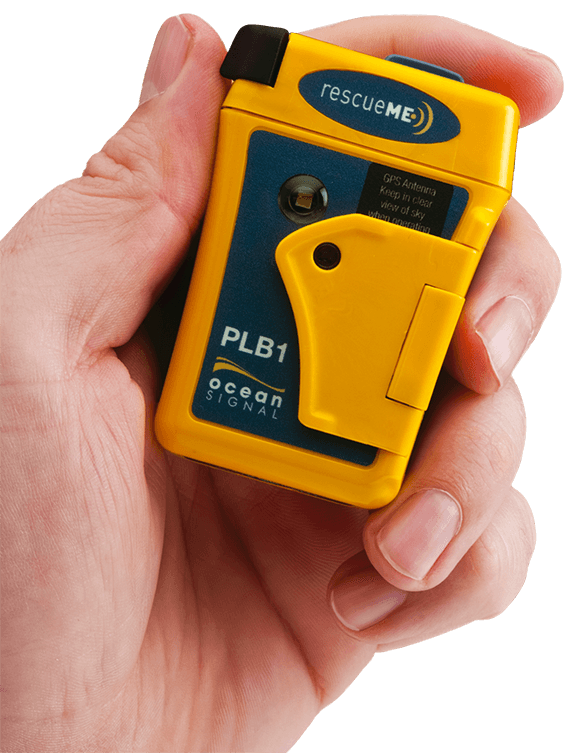
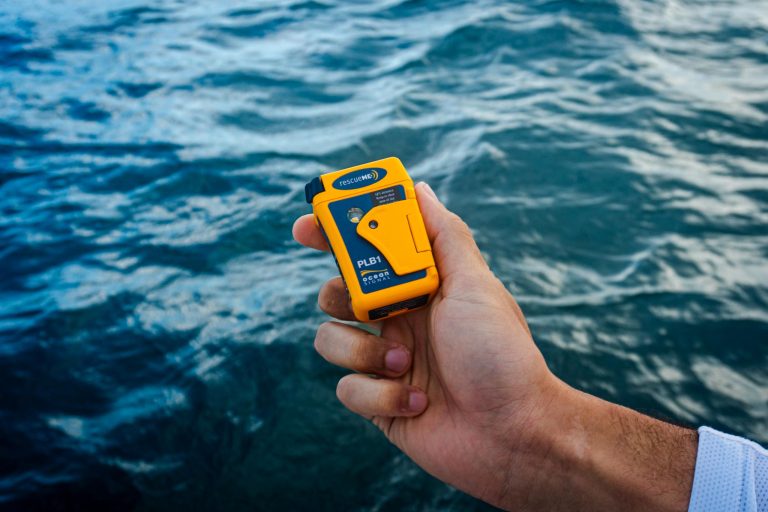
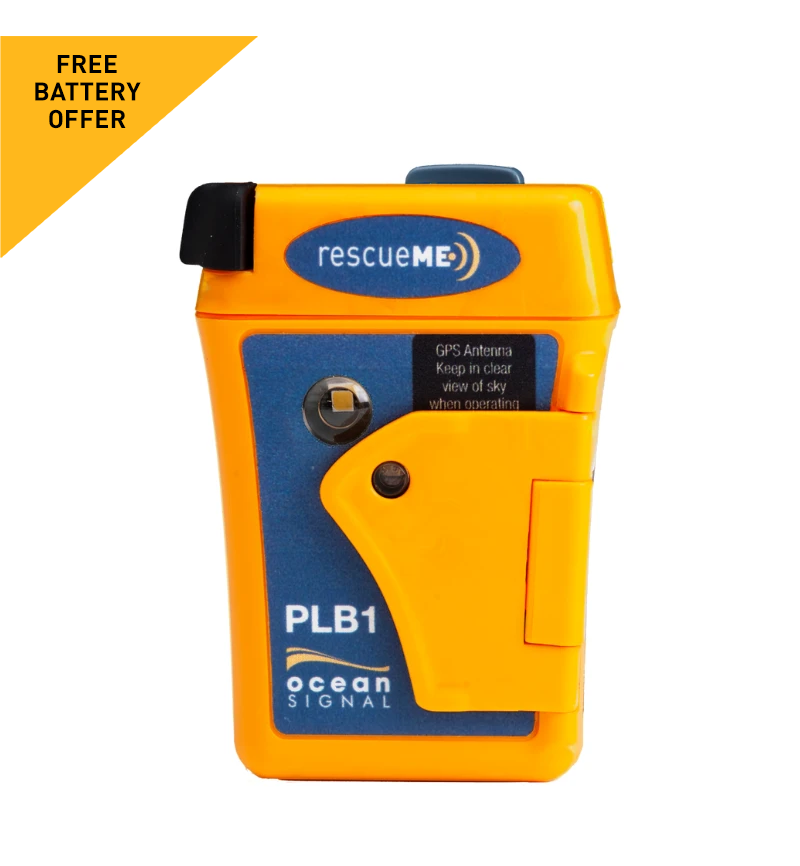
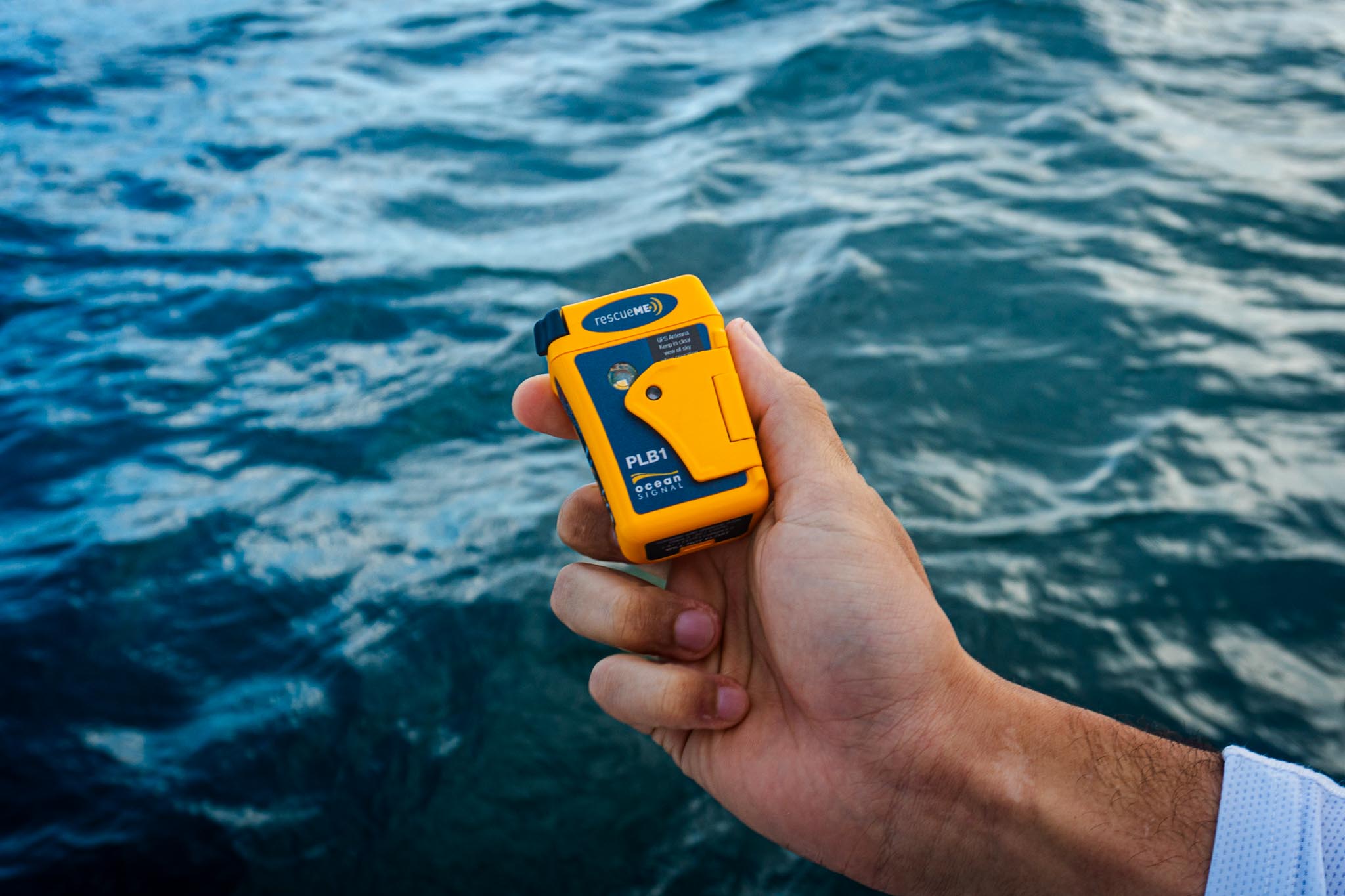
The rescueME PLB1 is a compact Personal Locator Beacon for hikers, sailors, paddlers and pilots. Manual activation sends a 406 MHz distress alert and available GPS position through the global Cospas-Sarsat satellite system, without mobile coverage or subscription fees. Carry it secured and within reach for a life-threatening emergency.
From the trail to the cockpit, carry a dedicated way to call for help in a life-threatening emergency.
LAND
Hikers & explorers
For hiking, hillwalking and remote adventures, where an injury or sudden change in conditions can leave you needing help beyond mobile coverage.
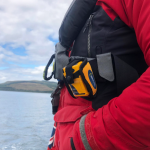
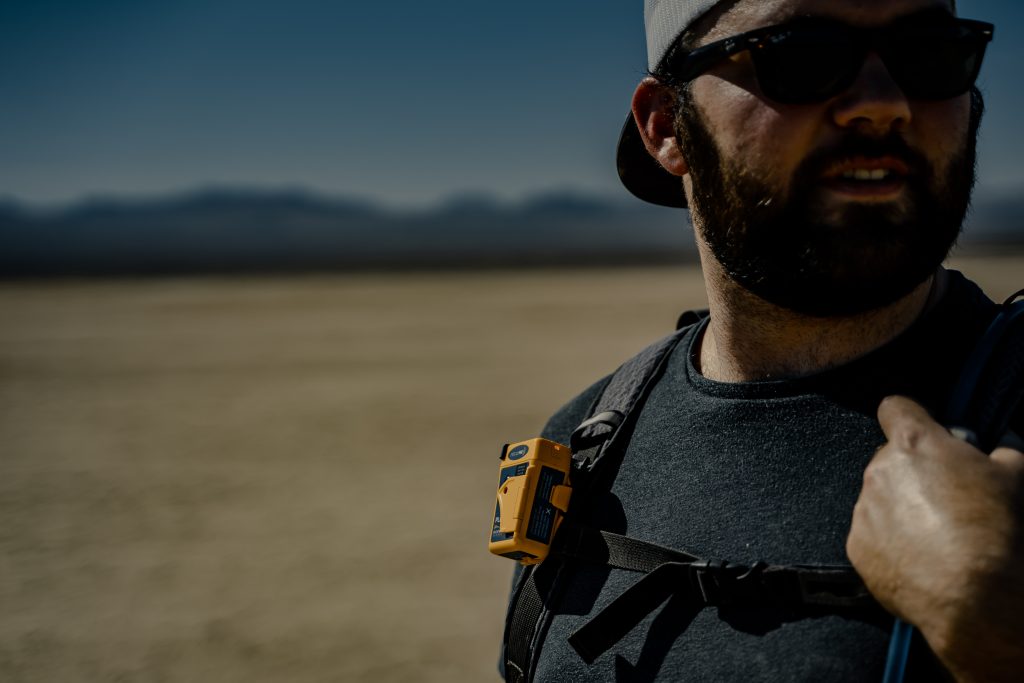
Clip it to your backpack strap or belt and secure the lanyard.
Water
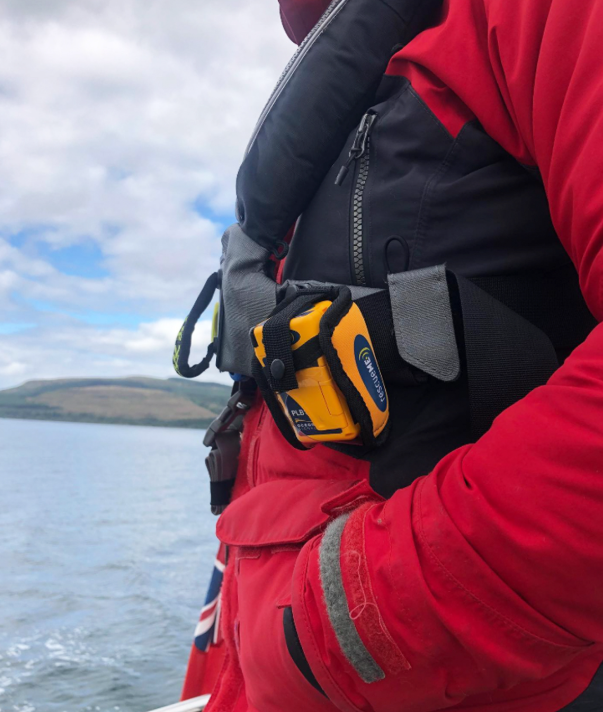
Boards, paddles & boats
For foil boarding, kite surfing, kayaking, stand-up paddleboarding (SUP), sailing and boating. Carry a personal locator beacon for emergencies on the sea, lakes or rivers.
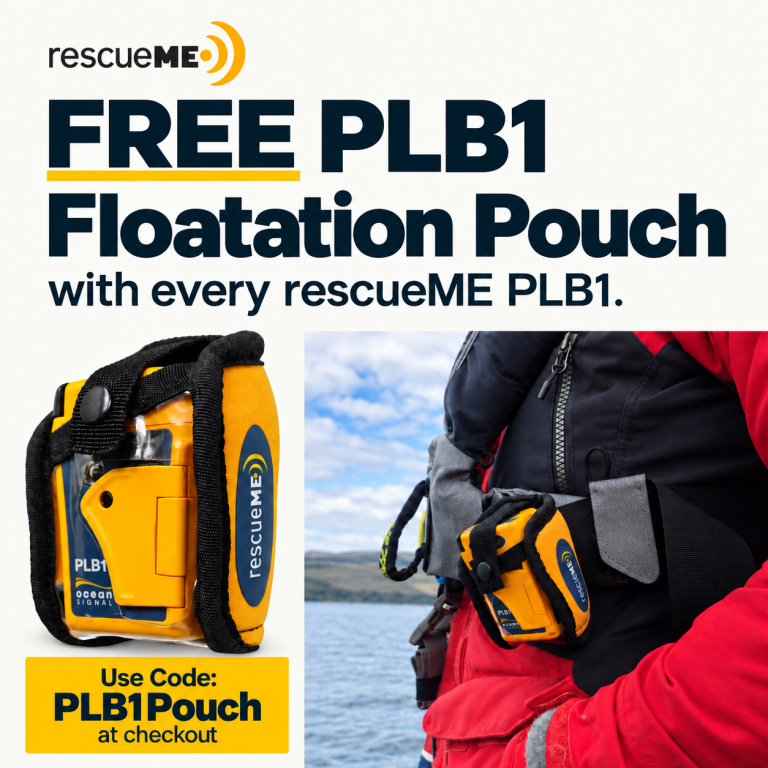
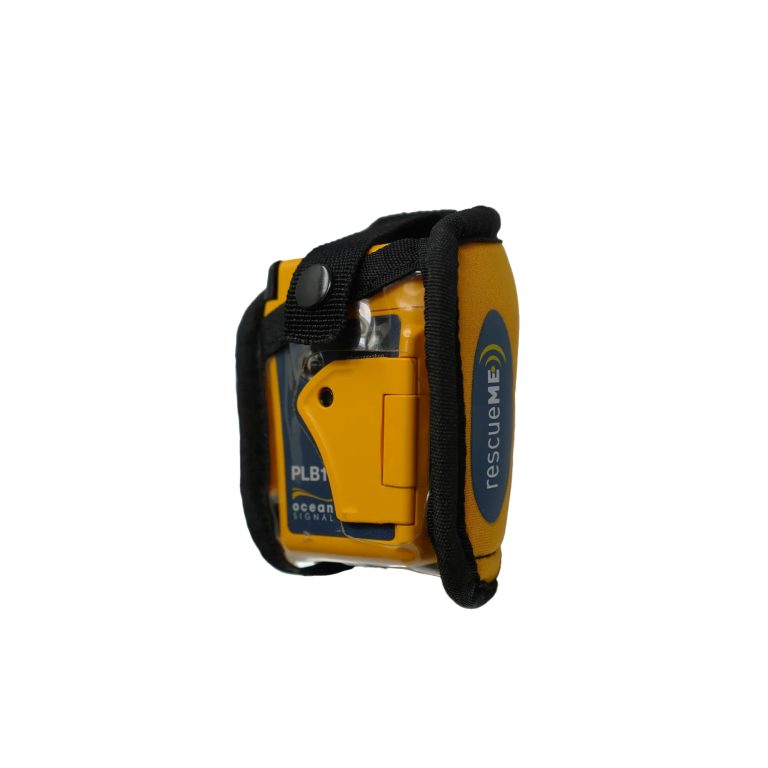
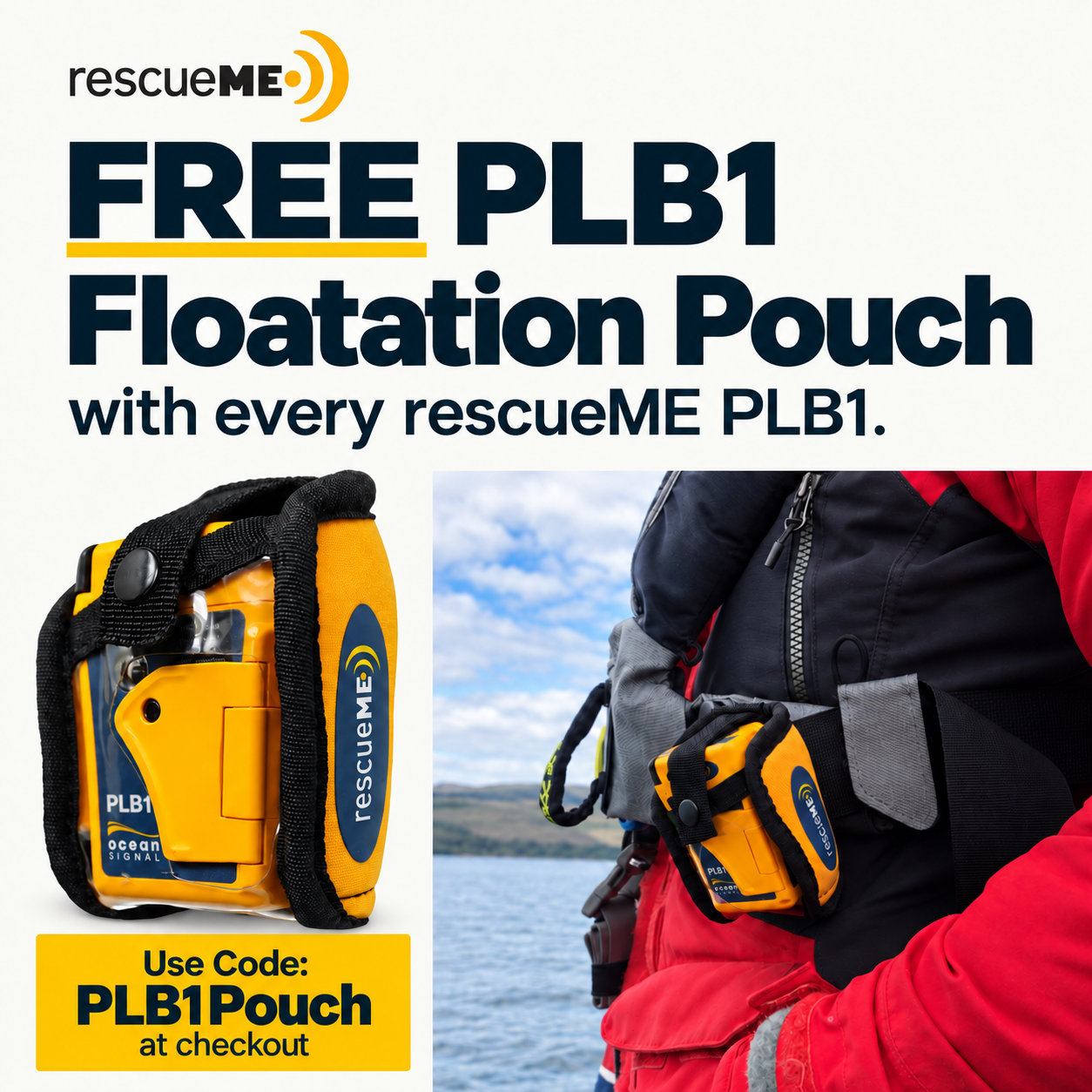
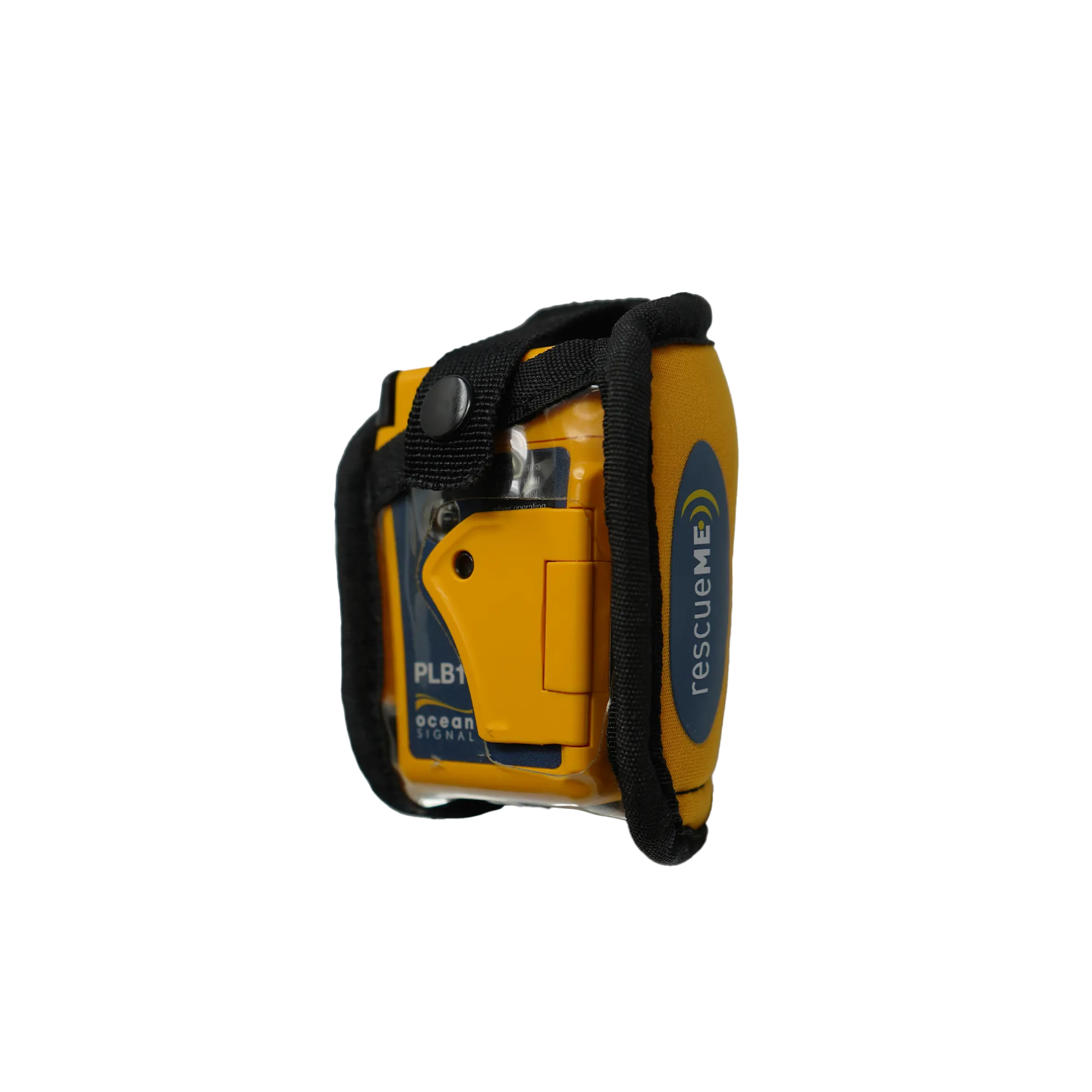
Use the flotation pouch for buoyancy and keep the beacon tethered.
AIR
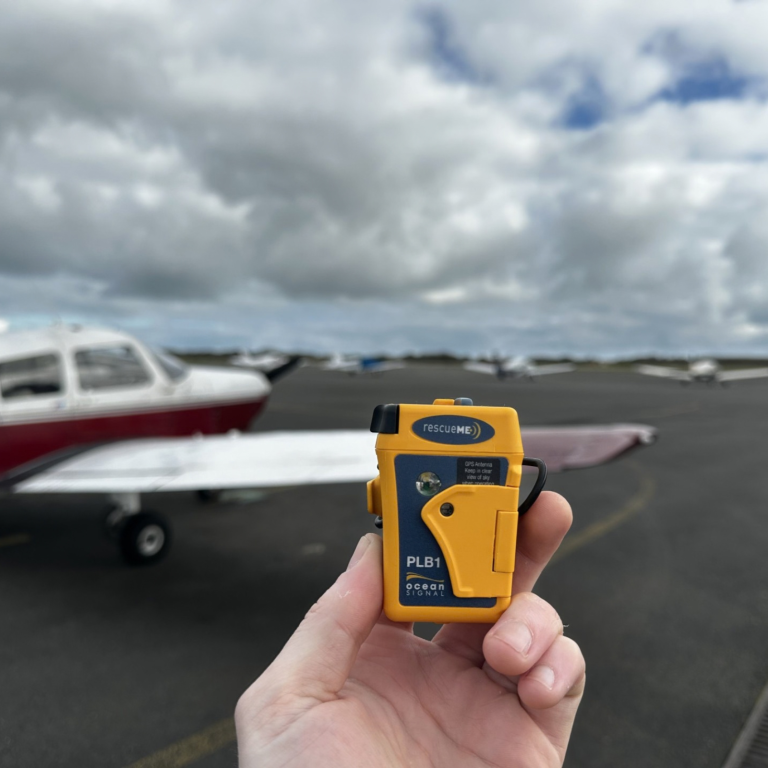
Pilots & aircrew
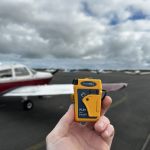
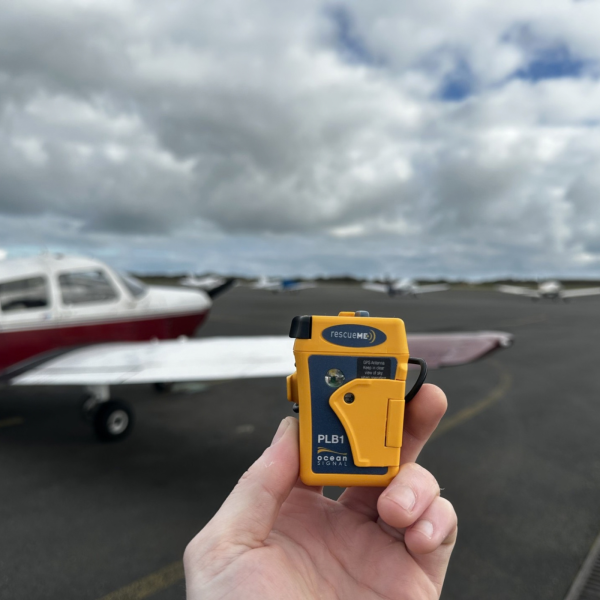
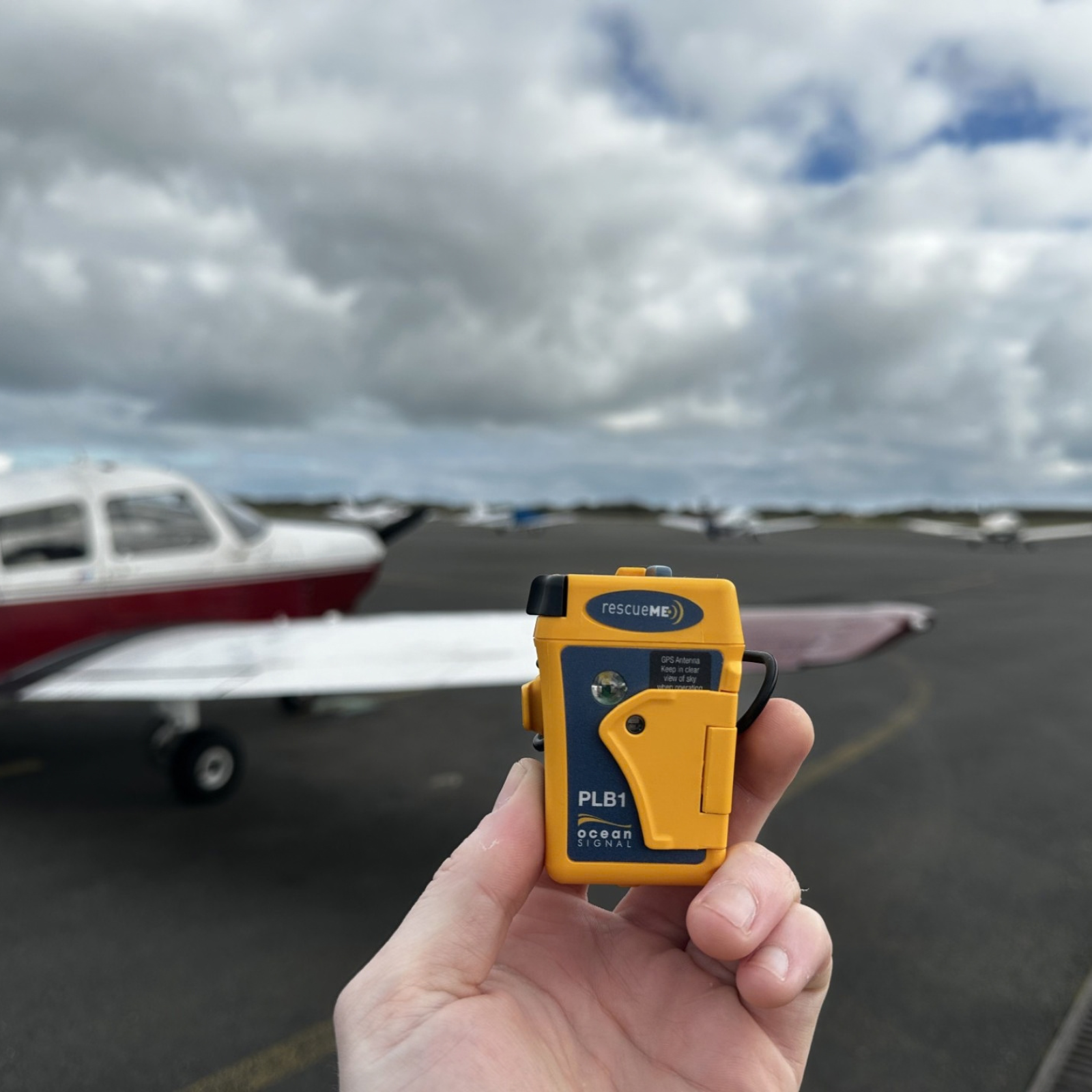
For private pilots, aircrew and remote-area flying. Carry a personal beacon in your survival kit for an emergency after a forced landing or ditching.
Personal survival equipment alongside your aircraft’s emergency equipment.
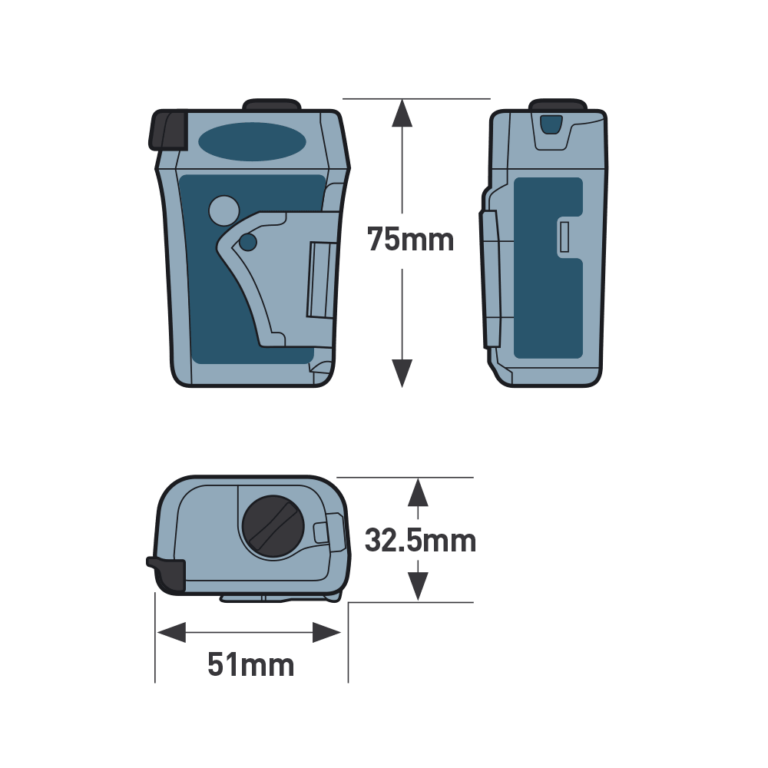
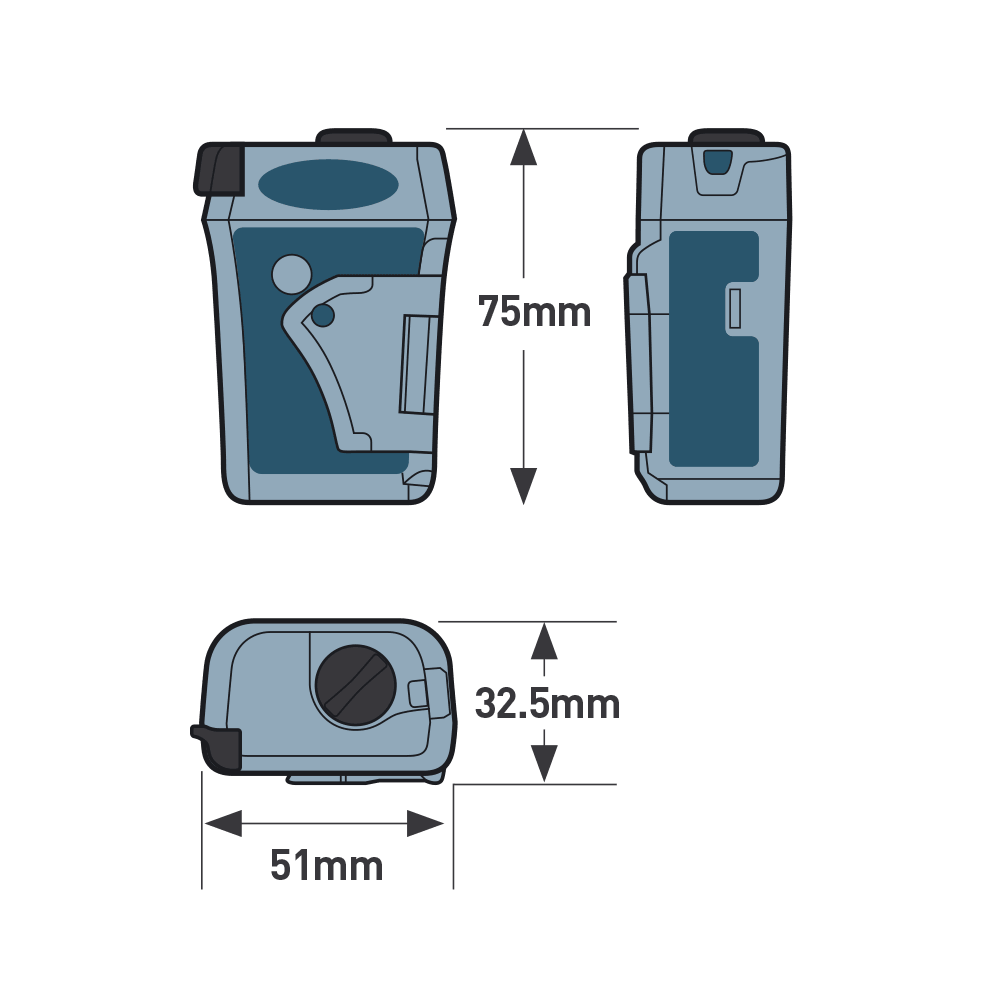
The world’s smallest PLB
Small enough to carry. Serious enough for the worst day.
The PLB1 concentrates dedicated emergency alerting into a compact, manually activated beacon. Its small size matters because emergency equipment only helps when it is on you, secured and within reach.
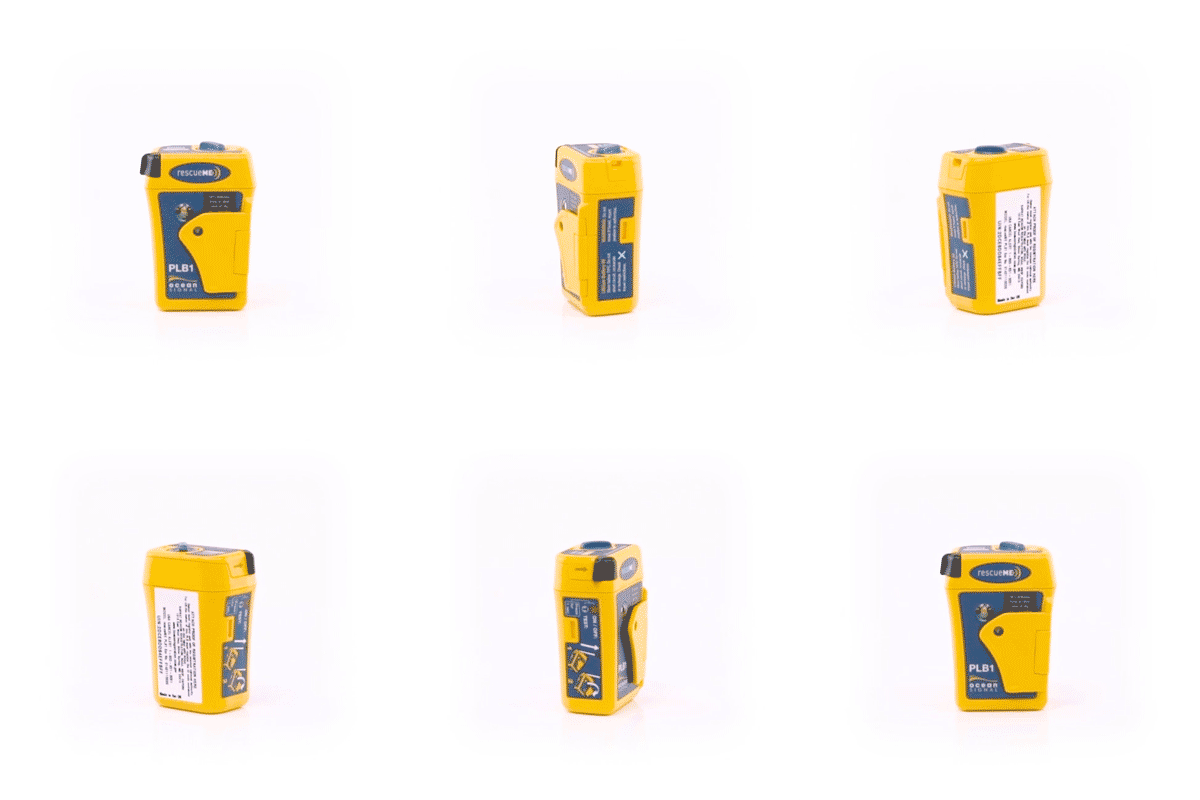
✓ The world’s smallest Personal Locator Beacon for compact carriage across activities.
✓ Unique mounting clip for securing the beacon where it can be reached.
✓ Retractable antenna and protected activation control designed for emergency deployment.
✓ Waterproof to 15 metres for demanding marine and outdoor conditions.
Real People. Real Rescues.
Proven when it matters most
Actual rescue photographs. First-hand accounts. See how the rescueME PLB1 helped these people get professional help when they could not get out safely.
Real-worldProven
Land & waterReal emergencies
Real photosFrom these rescues
PLB1Product-specific rescues
Helicopter winch rescue
Mountain running
Winched from a freezing mountain ridgeline
After a fall during the Mount Difficulty Challenge, Georgia lay injured on an exposed rocky outcrop, at risk of hypothermia. A race volunteer activated his rescueME PLB1. A helicopter paramedic reached her and winched her off the mountain.
“Thanks for creating such an awesome product.”Race volunteer, in Georgia’s published rescue account
On a sea-kayaking trip at Wilsons Promontory, Andy’s friend became seriously unwell. Wind and spray made phone communication difficult as the rising tide reduced their shelter. At the emergency operator’s request, Andy activated his PLB1. His friend was winched aboard an ambulance helicopter and taken to hospital.
“the simplicity of activating my PLB1 freed me up to concentrate on managing my friend’s medical condition.”Andy, sea kayaker and paramedic
On the Routeburn Track, Jon and his partner found an injured hiker with a head injury and a badly cut knee. The nearest road was at least a day and a half away on foot. They activated their rescueME PLB1, and a search-and-rescue helicopter airlifted the hiker to medical care.
“Even on easier, busy trails, a PLB can make a huge difference.”Jon, who activated the PLB1 for a fellow hiker
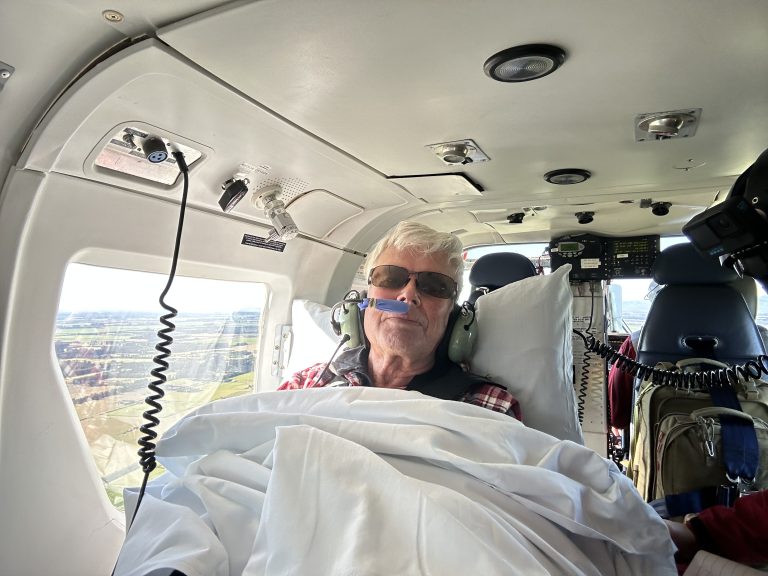
During a fishing trip to Broken River, 80-year-old Gary became faint and collapsed in sub-zero conditions. He activated his PLB1 while alone. After his companion returned to help, helicopter medics assessed Gary and flew him to Christchurch Hospital.
“hearing that helicopter coming was a moment I’ll never forget.”Gary, pictured aboard the rescue helicopter
Rescue stories from people who carried their beacon when it mattered.
Independent perspectives
What the reviewers say
Independent PLB1 reviews and coverage from outdoor, marine and aviation publications. Read their verdicts and the full context.
Outdoor gear test
OutdoorGearLab
“great value and very compact stature”
Recognises the PLB1 for SOS without a subscription, highlighting its compact size and straightforward emergency role.
Outdoor review & comparison
HikingGuy
“The PLB1 wins on simplicity and transmit power”
Explains the PLB1’s dedicated SOS role and the trade-offs compared with a two-way satellite messenger.
Marine product coverage
Yachting Magazine
“Here’s one for your tender kit and life-raft ditch bag”
Introduces the PLB1 as compact emergency equipment for time afloat, with no monthly subscription.
Aviation review
FLYER
An aviation perspective on the PLB1
Read FLYER’s independent rescueME PLB1 review when considering your personal emergency equipment for flying.
Compact emergency readiness
Built to stay close—and ready when needed
Clip the compact PLB1 to a backpack strap or belt, or carry it in its flotation pouch for boating—so it stays secured, visible and within reach.
1
Clip it within reach
Attach the PLB1 to a backpack strap or suitable belt webbing, and secure its lanyard so the beacon stays with you.
2
Add buoyancy for boating
For boating or sailing, fit the flotation pouch and keep the PLB1 tethered. The pouch adds buoyancy but does not hold the beacon upright.
3
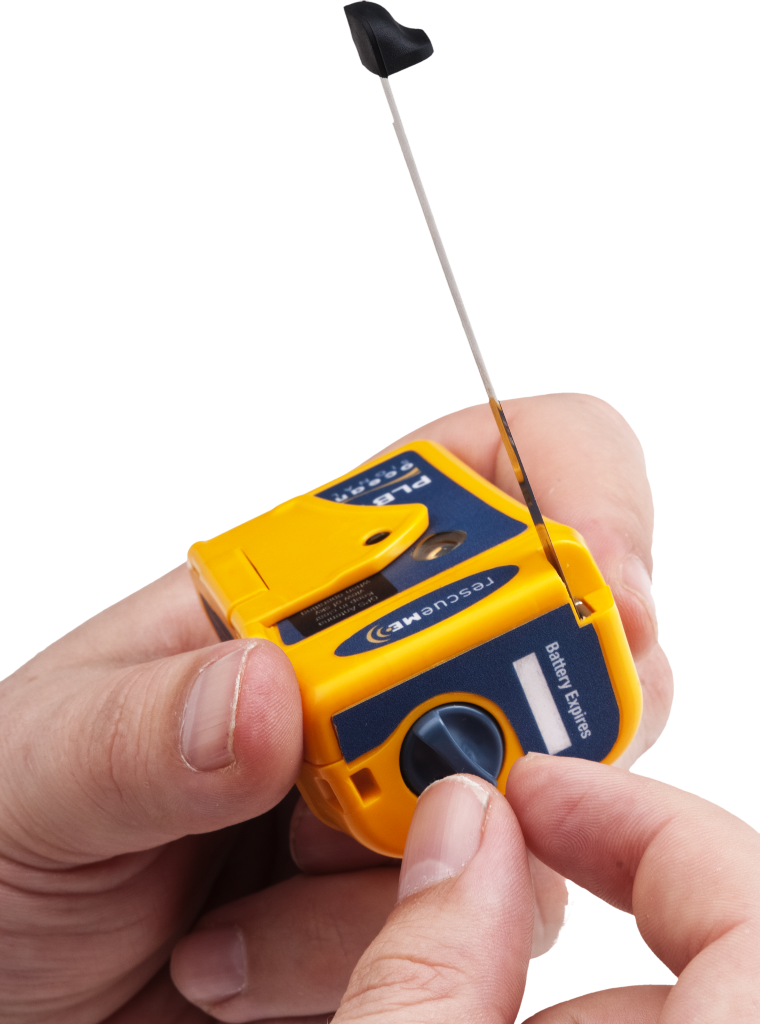
Deploy the antenna
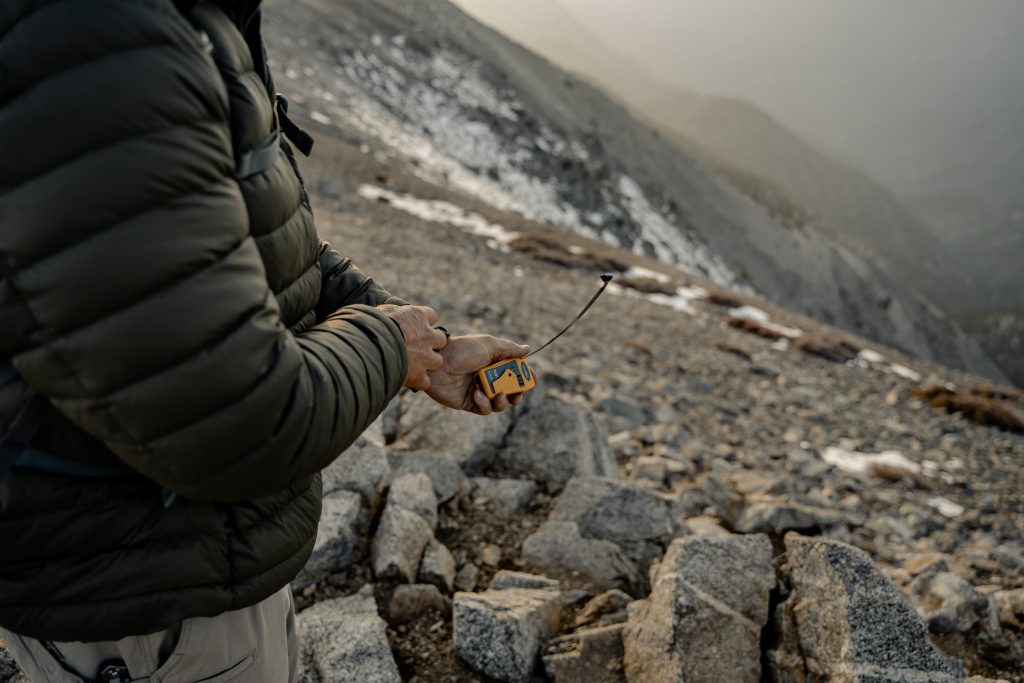
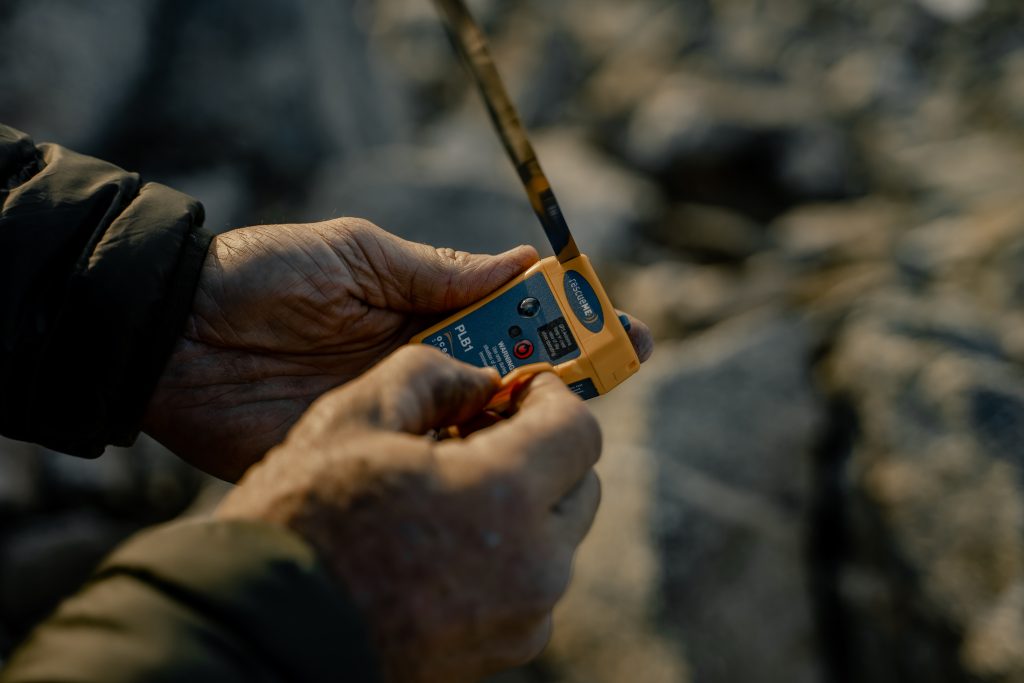
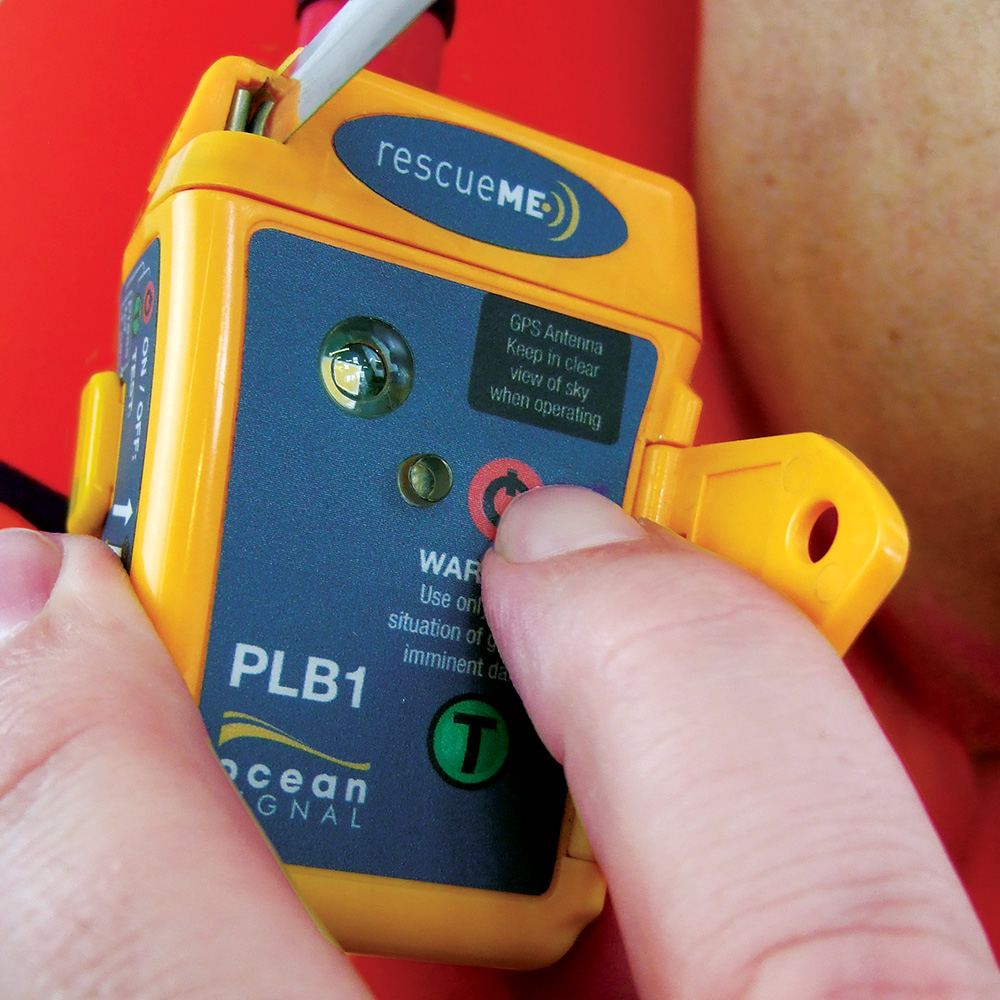
In an emergency, extend the antenna and position the beacon upright with the clearest practical view of the sky.
4
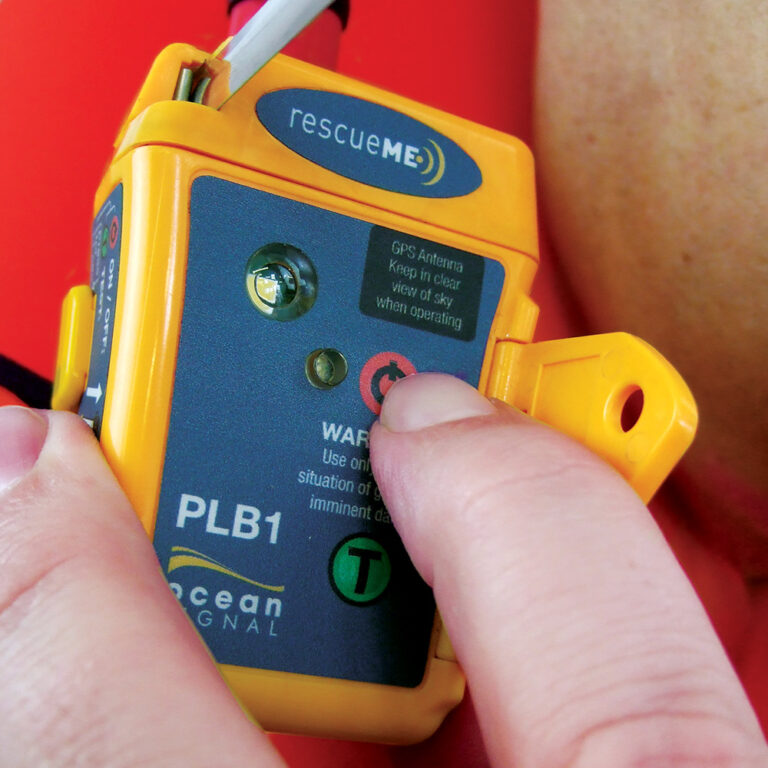
Activate for a real emergency
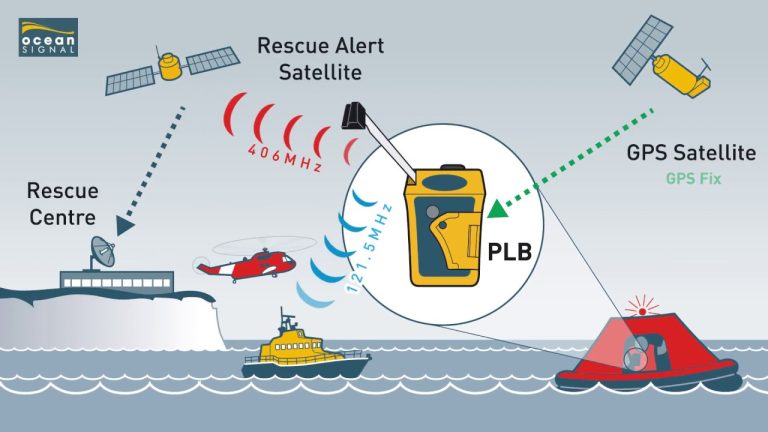
Manual activation starts the 406 MHz distress transmission, GPS positioning, 121.5 MHz homing signal and visible strobe.
Important flotation note: the standard PLB1 does not float without the optional flotation pouch, and the pouch does not hold the beacon in its required operating position. Keep the beacon firmly attached by its lanyard and hold or support it upright during activation. Australia/New Zealand configurations have market-specific pouch requirements. View the PLB1 Floatation Pouch.
Subscription-free emergency protection
No subscription fees. Ever.
No monthly plan. No annual service fee. The PLB1’s 406 MHz emergency alerting works through Cospas-Sarsat. Register before use and keep the battery within its replacement date.
0
Monthly or annual subscription fees for the PLB distress function.
No mobile signal required
Designed for emergencies offshore and beyond normal network coverage.
7-year battery interval
Replace by the date on the beacon, or after emergency activation, through an authorised centre.
24+ hours at −20°C
Specified operating duration after activation, with a battery within its replacement date.
A PLB does not provide routine tracking, weather, non-emergency messaging or two-way conversation. Choose it when dedicated, subscription-free distress alerting is the priority. See the practical differences in PLB1 versus iPhone Emergency SOS.
Global search and rescue technology
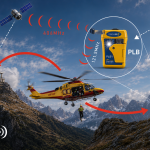
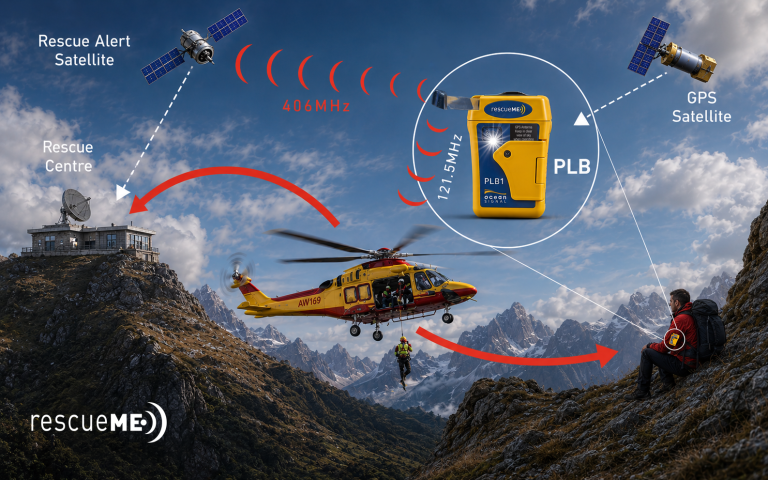
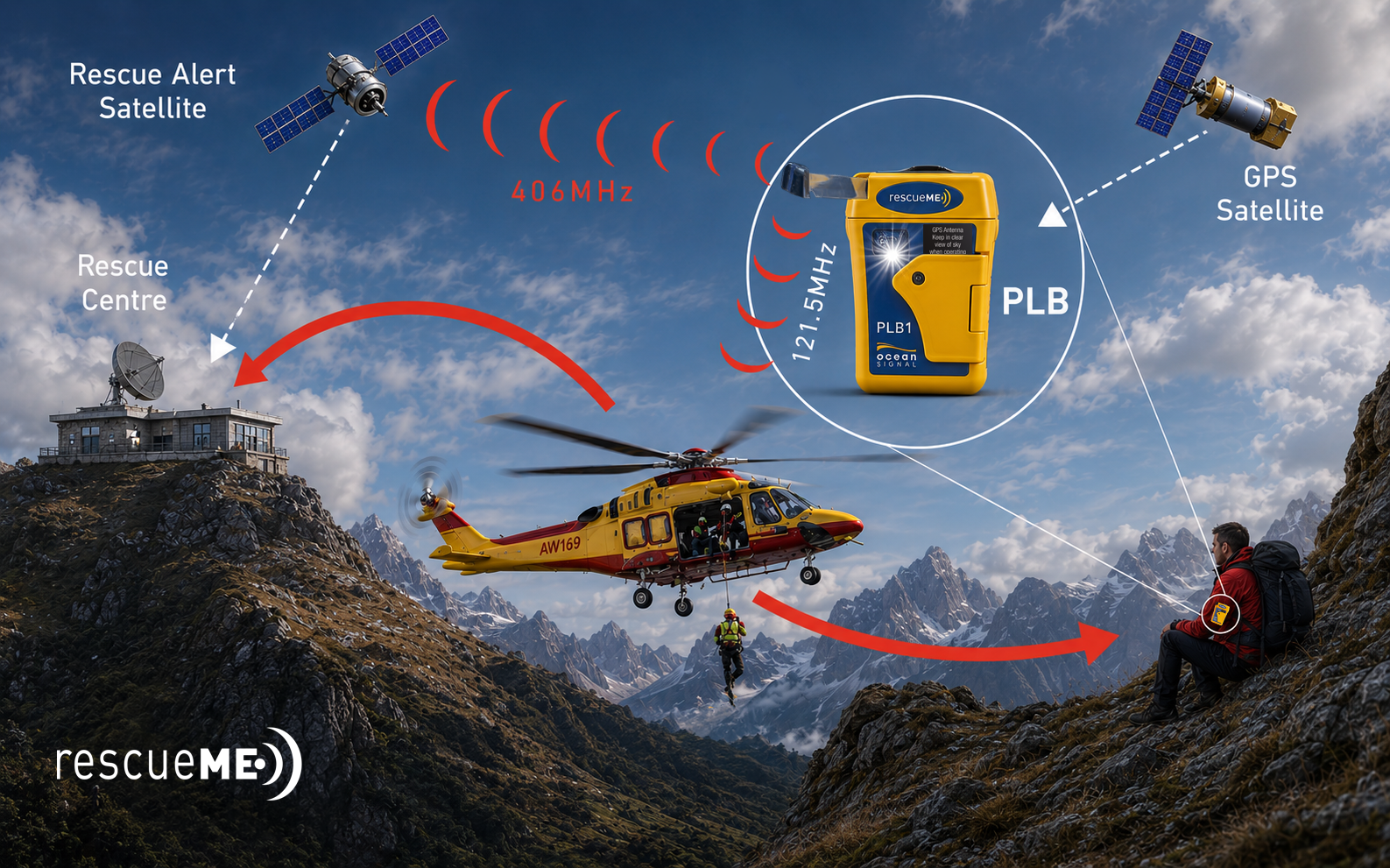
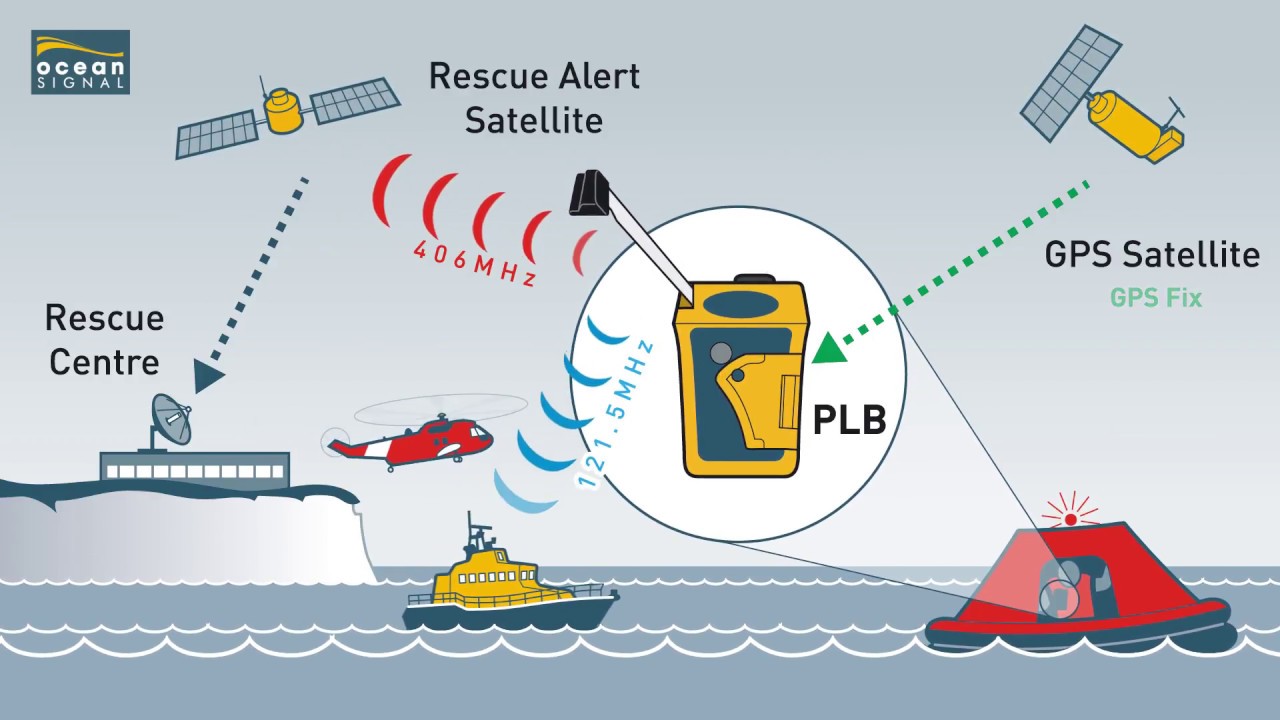
How the rescueME PLB1 helps Search & Rescue find you
1
GPS positioning
The built-in GPS receiver determines the beacon’s position so available location data can be encoded into the distress message.
2
406 MHz distress alert
The beacon transmits its unique identity and available GPS position. Cospas-Sarsat satellites and ground stations pass the alert to the appropriate rescue coordination authorities.
3
121.5 MHz homing
Once rescue assets are in the area, the homing transmission helps equipped Search & Rescue teams close in on the beacon.
High-intensity visible strobe: provides an additional visual reference for nearby rescuers, especially at night or in difficult visibility.
Choose PLB1 for compact, subscription-free satellite distress alerting. Choose PLB3 when you also want AIS alerts to nearby equipped vessels, Return Link Service (RLS) acknowledgement and compatible lifejacket integration.
Compare features
rescueME PLB1
Compact dedicated PLB
rescueME PLB3
AIS + RLS + NFC
No subscription required
Yes
Yes
406 MHz satellite alert
Yes
Yes
121.5 MHz homing
Yes
Yes
Positioning
GPS
GPS + Galileo + GLONASS
AIS local alert
No
Yes
RLS return link
No
Yes
NFC app status
No
Yes
Strobe
High-intensity visible
Visible + infrared
Activation
Manual
Manual / lifejacket¹
Battery interval
7 years
Up to 6 years²
Operation at −20°C
24+ hours
24+ hours
¹ PLB3 supports semi-automatic activation when correctly installed in a compatible inflatable lifejacket. ² Replace its battery 6 years from manufacture or 5 years after entering service, whichever comes first. For both models, follow the battery date and replacement instructions in the manual.
RLS confirms that the distress alert has been received and the beacon’s location determined. It does not confirm that a rescue has been dispatched. Follow the relevant manual for lifejacket installation, testing and activation.
Choose the correct country coding, register your beacon and learn the operating procedure before your first trip.
Free country programming
Buy directly from Ocean Signal and country programming is included at no extra charge. Confirm the coding you need when ordering; programming and owner registration are separate steps.
Register before you go
Register the beacon’s unique identity with the authority for its country coding. Keep your contact details, emergency contacts and trip information current.
Know it before you need it
Read the manual, practise locating the controls and use only the specified self-test procedure. Secure the lanyard and check the battery replacement date before travelling.
Short answer: PLB1 is a dedicated 406 MHz Cospas-Sarsat distress beacon. Satellite-capable phones and communicators can add valuable two-way communication, but use different commercial satellite services and device requirements. Register PLB1 with the official 406 MHz authority for its country coding.
Choosing your beacon
How does PLB1 compare with a mobile phone or iPhone Emergency SOS via satellite?+
They solve the same emergency problem in different ways. Ordinary mobile emergency calls still depend on available terrestrial coverage. A compatible iPhone can support interactive satellite emergency messaging, but it requires a charged, working phone, a supported country and model, onscreen interaction and following directions to maintain a satellite connection. The PLB1 is a dedicated, rugged 406 MHz distress beacon with reserved emergency battery power and 121.5 MHz homing. When practical, carry both rather than treating either as a universal replacement. Read the full PLB1 versus iPhone Emergency SOS comparison.
What is the difference between a PLB and a satellite communicator?+
A PLB is a dedicated one-way distress beacon. The PLB1 sends a 406 MHz alert through Cospas-Sarsat and provides 121.5 MHz homing, with no monthly subscription. Satellite communicators offer features such as two-way messages, check-ins and tracking; service plans and SOS terms depend on the device and provider. Compare PLBs and satellite communicators.
What is the difference between Iridium and Cospas-Sarsat?+
Iridium is a commercial communications network used by compatible satellite phones and messengers. Cospas-Sarsat is an international search-and-rescue system for 406 MHz distress beacons. PLB1 uses Cospas-Sarsat, provides no routine two-way communication and needs no distress-alerting subscription.
Does iPhone Emergency SOS use Cospas-Sarsat?+
No. iPhone Emergency SOS via satellite does not transmit a 406 MHz Cospas-Sarsat beacon alert. PLB1 uses Cospas-Sarsat and adds 121.5 MHz homing for equipped rescue teams. Phone availability and features depend on the model, software and country; see the PLB1 versus iPhone guide.
Should I carry a PLB as well as a phone or satellite communicator?+
For many remote users, yes. A phone is valuable for calls, maps and everyday communication, while a satellite communicator can provide off-grid messaging, tracking and check-ins. A PLB adds a dedicated emergency distress path with long-life reserve power and no distress-alerting subscription. The right combination depends on your activity, risk, local rules and need for routine communication.
What is the difference between a PLB1 and an EPIRB?+
A PLB1 is registered for personal use, carried by an individual and manually activated. An EPIRB is designed around vessel-level maritime distress alerting; depending on its model and bracket, it may provide float-free release and automatic activation, and it normally has a longer required transmission duration. A PLB can complement an EPIRB but does not automatically replace required vessel equipment. See the PLB versus EPIRB explanation.
Can a PLB1 replace an aircraft ELT?+
Not automatically. An ELT is aircraft emergency equipment and may be installed and crash-activated, while the PLB1 is a manually activated personal survival beacon carried by a pilot or passenger. A PLB can add a valuable independent rescue-alerting layer, but pilots must check the current ELT, PLB, coding and carriage requirements for the aircraft’s registration, route and operation. See the PLB, EPIRB and ELT guide.
What is the difference between rescueME PLB1 and rescueME PLB3?+
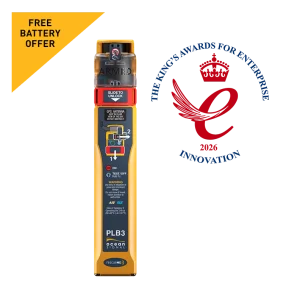
Choose PLB1 when minimum size and straightforward 406 MHz satellite distress alerting are the priorities. The rescueME PLB3 adds nearby-vessel AIS alerting, Return Link Service acknowledgement, NFC status access, an infrared strobe and compatible-lifejacket integration. PLB3 is the more feature-rich marine option when those additional alert and confirmation paths matter.
Buying and getting ready
Is country programming included when I buy direct?+
Yes. When you buy directly from Ocean Signal, country programming is included at no extra charge. Confirm the required coding when ordering. You must still register the programmed beacon with the appropriate national authority before use.
Where do I register my rescueME PLB1?+
Register the beacon with the official 406 MHz authority for its country coding—normally your country of residence or, where applicable, the country of vessel registration. Registration is free in many markets. Official starting points: United Kingdom, United States, Canada, Australia, New Zealand and France. For other countries, use Ocean Signal’s country registration guide or contact the national authority before use.
Why does PLB registration matter?+
The PLB1’s 406 MHz message contains a unique 15-digit HEX ID. Registration connects that identifier with owner, emergency-contact and activity information, helping rescue authorities verify the alert and understand who or what they may be looking for. Update the record whenever your contact, vessel, aircraft or emergency information changes.
Does my beacon’s HEX ID contain zero or the letter O?+
It contains the number 0 (zero), never the letter O. A 15-character HEX ID uses only digits 0–9 and letters A–F. Copy the identifier exactly when registering your beacon.
Can I use a PLB1 in another country?+
A correctly coded and registered PLB1 can be activated worldwide through Cospas-Sarsat. Keep emergency contacts informed of your travel plans and check the destination’s rules for beacon registration, country coding, maritime or aviation recognition and required safety equipment before relying on it.
Can I take the PLB1 in hand luggage or checked baggage?+
Generally yes, subject to your airline’s rules. The installed PLB1 battery contains 1.65 g of lithium. Prefer hand luggage, keep the beacon switched off and protect it against damage and accidental activation. If your airline permits checked carriage, the same protections are essential. Check with the airline before travelling and have the PLB1 battery safety data sheet (PDF) available.
Does the PLB1 work without mobile or Wi-Fi coverage?+
Yes. The PLB1 does not depend on a phone, mobile network or Wi-Fi. When activated, it sends a 406 MHz distress alert and available GPS position through the international Cospas-Sarsat satellite system.
Does the rescueME PLB1 require a subscription?+
No. There are no monthly or annual subscription charges for the PLB1’s 406 MHz emergency distress function. The beacon must still be registered correctly, maintained and have its battery replaced when required.
What is the 406 Survivor Club—and will Ocean Signal replace my PLB1 after a rescue?+
Ocean Signal offers a free replacement beacon to PLB and EPIRB owners after a qualifying lifesaving rescue story is approved and shared. Submit your account and supporting images, and follow the team’s eligibility and return instructions. Replacement is subject to programme approval. See the Survivor Club and submission route.
What warranty is available for the PLB1?+
The PLB1 has a two-year limited warranty. Register the product with Ocean Signal within 90 days of purchase to add three years, subject to the current terms. This warranty registration is separate from registering your beacon with the rescue authority. Keep your receipt and review the Ocean Signal warranty policy.
Using and maintaining PLB1
What happens after I activate the PLB1?+
Activation starts the distress alerting process. Cospas-Sarsat satellites and ground stations route the beacon’s identity and available GPS position to rescue coordination authorities. Equipped rescue teams can use 121.5 MHz homing to close in; the visible strobe adds a visual reference. The PLB1 does not receive acknowledgement or a rescue arrival time.
How accurately can rescuers locate a PLB1?+
Cospas-Sarsat can determine a beacon’s location from its radio transmission. The PLB1 also sends an encoded GPS position when it has a fix; Ocean Signal quotes typical GPS-position accuracy within 100 metres. These are complementary location methods, while 121.5 MHz homing helps equipped rescue teams locate the beacon nearby. Sky visibility and obstructions affect GPS acquisition, so follow the operating-position guidance in the manual.
Does the rescueME PLB1 float?+
The standard PLB1 does not float without a flotation pouch. The optional PLB1 Floatation Pouch provides buoyancy, but it does not hold the beacon in its operating position. Tether it securely and keep the beacon clear of the water during activation.
Why do Australian and New Zealand PLB1s have an attached pouch?+
Ocean Signal supplies these regional versions with a permanently attached flotation pouch to meet local buoyancy requirements. The pouch helps the beacon float but does not keep it upright for operation. For changes to the attachment or a land-use setup, ask Ocean Signal about your exact regional version before making alterations.
Can I attach the PLB1 to a lifejacket?+
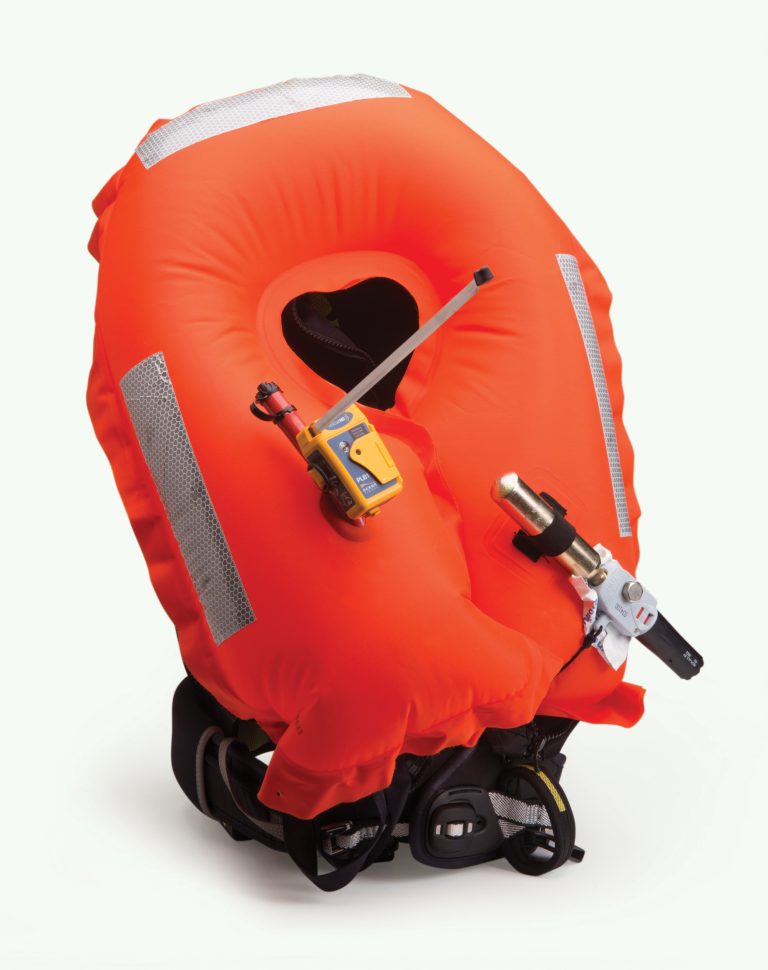
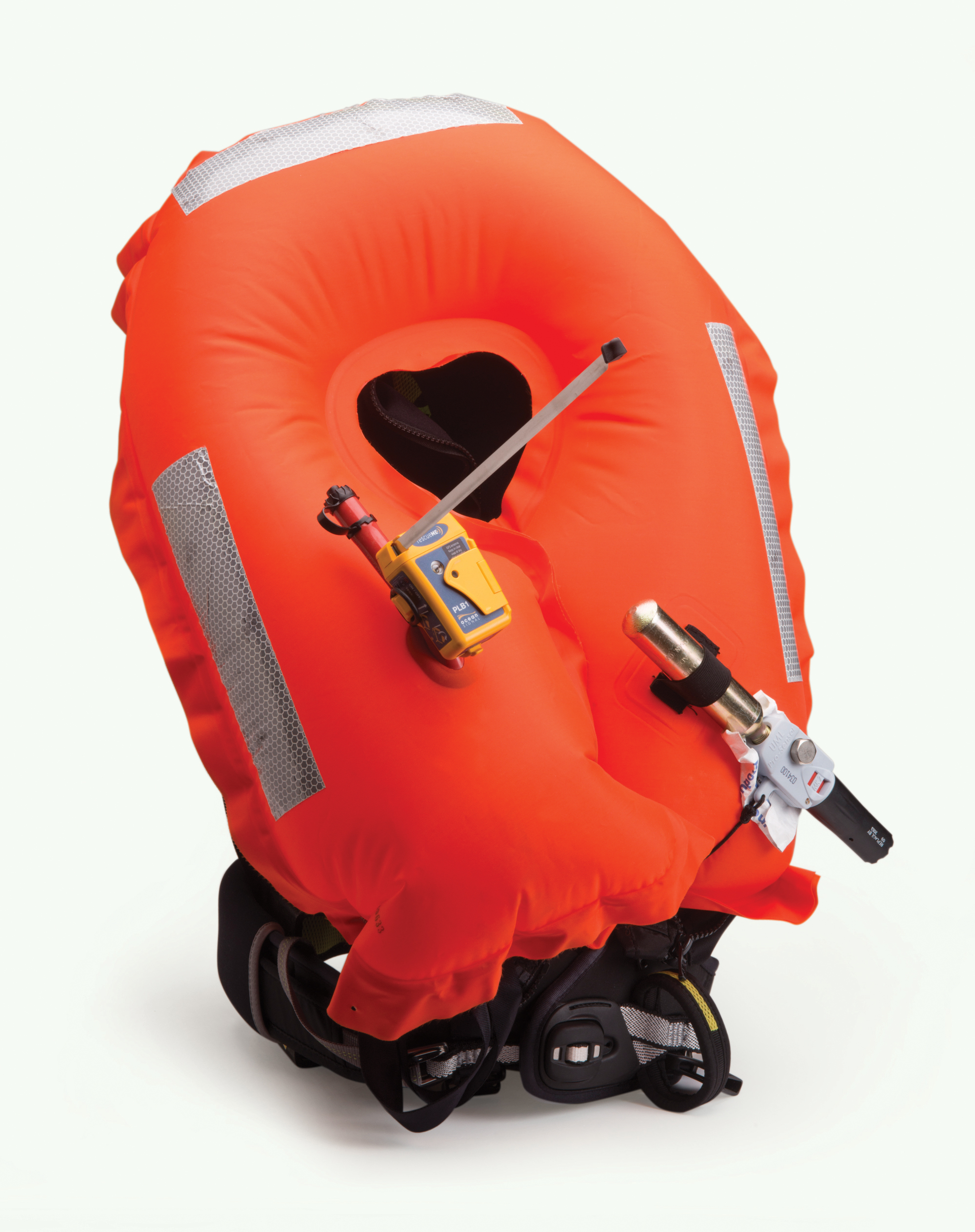
The mounting clip can keep the PLB1 accessible, but always follow the lifejacket manufacturer’s installation instructions and secure the beacon with its lanyard. If integrated inflatable-lifejacket activation is essential, compare the rescueME PLB3.
Is the PLB1 manually or automatically activated?+
The PLB1 is manually activated and should only be used in grave and imminent danger. Deploy the antenna and follow the instructions printed on the beacon and in the manual. If it is activated accidentally, deactivate it and contact the nearest Coast Guard or Rescue Coordination Centre promptly to report the false alert.
How long does the PLB1 battery last—and can I replace it?+
The PLB1 battery is replaceable by an Ocean Signal authorised battery replacement centre, not by the owner. Its replacement interval is seven years, with more than 24 hours of specified operation at −20°C. Replace it before the marked expiry date, after any emergency activation—even a brief one—or when the self-test shows amber/orange or a battery-replacement warning. Have it serviced before relying on it again.
How do I test the rescueME PLB1?+
The PLB1 provides beacon and GPS test functions. Follow the exact procedure, timing and permitted test frequency in the current PLB1 user manual, because every test uses a small amount of battery capacity and GPS tests are limited.
What do repeated green or amber flashes mean in the beacon self-test?+
A single green flash followed by another after a pause is the same status result shown twice. Amber means the battery has accumulated use or exceeded its test allowance; the number of flashes in each group indicates the usage band. Have the battery replaced before relying on the beacon again. This describes the beacon self-test: GPS-test flashes have a different meaning. Use the tables in the PLB1 manual (PDF), sections 4.1 and 4.2.
Can the PLB1 send messages, track me or confirm rescue is coming?+
No. PLB1 provides one-way distress alerting, with no routine tracking, check-ins, two-way messaging or RLS acknowledgement. PLB3 adds RLS to confirm receipt and location of the distress alert; that does not mean rescue has been dispatched. Choose a suitable satellite communicator if you also need routine off-grid messages.
What should I do with a PLB1 that is being permanently retired?+
Prevent false alerts by arranging permanent deactivation and battery removal before disposal. Tell the beacon registration authority it is no longer in service, and use appropriate local battery and electronics recycling. Contact an authorised service centre for instructions: the PLB1 is not user-serviceable, and opening its case invalidates the warranty.
Important: the standard PLB1 does not float without the flotation pouch, and a personal beacon does not automatically replace any EPIRB, ELT or other equipment required for your vessel, aircraft or activity.
ENTER YOUR PRODUCT DETAILS TO GAIN THE EXTENDED WARRANTY PERIOD. NOTE: The product comes with a 2-year warranty which can be extended by 3-years as referenced below.
Select ‘Activate New Product Warranty’ and entering your beacon’s details – once saved, the warranty policy of the product will then be extended by an additional 3-Years.
The purchase receipt must be provided when submitting a warranty claim.
When I register my EPIRB or PLB is the 0 in the 15 digit HEX ID (UIN) the number 0, or the letter O?
The HEX ID consists of the numbers from 0 to 9 and the letters from A to F only. The character 0 is the number zero.
If I register my PLB in one country, can I use it in another country?
Yes, you can use your PLB anywhere in the World. When you register your PLB, make sure you give emergency contacts who will know where you are if you need to activate the PLB in an emergency. This aids the rescue authorities to make sure it is a real alert and will speed up your rescue.
What is the location accuracy of the rescueME PLB1?
The Cospas Sarsat system uses two methods of locating a beacon:
The satellite system is designed to locate your beacon using the transmission alone. The accuracy of this fix is approximately a 5 nautical mile radius, but is typically much better.
The rescueME PLB1 has a built in GPS receiver which is used to encode the position in the transmission. When the GPS has a reliable fix, usually within a few minutes, the accuracy is typically within 100 metres of your actual position can be achieved.
The combination of these two methods gives the rescue services the quickest and most accurate position.
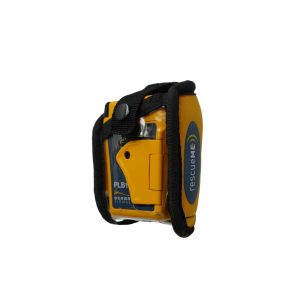
Why is the pouch permanently attached to the PLB1 (Aus/NZ only)?
For Australia and New Zealand the regulations require that the PLB must float. Because of the small size of the rescueME PLB1, the pouch is used to provide buoyancy and must be permanently attached when supplied in those countries.
If you require to remove the pouch for land based usage, cut the black cord leaving enough length to make a loop to re-attach the pouch or to tie a separate lanyard to.
When testing the PLB, I get two green flashes. What does this mean?
The test indication is repeated. So for a battery which has been used for less than one hour, you will see single green flash, which is repeated after a short pause.
If the battery has been used for over one hour, the indicator will change to an amber (orange) colour. Over two hours and the indicator will flash amber two or more times in a close group, which will be repeated after a short pause.
Carrying a PLB on aircraft as luggage.
The Ocean Signal rescueME PLB1 can be safely carried on board a passenger aircraft as either checked in or carry on luggage under section 2.3.5.9 of the IATA Dangerous Goods Regulations. The lithium metal battery in the rescueME PLB1 contains less than 2g of lithium and have been tested in accordance with 38.3 of the UN Manual of Tests. Precautions should be taken to prevent accidental activation if placed in checked in baggage.
Is the battery replaceable on the PLB1?
Yes, the battery will be replaceable after the expiry period or after the unit has been activated. The battery is not user replaceable and must be sent to an authorised service dealer for replacement. Please view our Dealer Locator to find a nearby authorised Battery Replacement Centre.
When should I replace my PLB1 battery
Under normal circumstances the battery in the PLB1 should be replaced before the expiry date marked on the unit.
If the unit has been activated in emergency or if the test indicator LED is flashing amber (orange) the battery must be replaced before it is used again to ensure the full 24 hours of operation in emergency.
The typical lifetime of the PLB1 is greater than 24 hours, but this is under defined conditions of storage and test usage. Do not assume that just because the activation was only for a short length of time the battery will not need exchanging.
Details of battery exchange in your region can be found by enquiring with your local distributor. Please see http://oceansignal.com/support/dealer-locator/ for information on our distributors.
Disposal of EPIRBs and PLBs
Care should be taken when disposing of your PLB or EPIRB when it is no longer required. False alerts from discarded beacons can cause rescue authorities to expend much time and effort in locating discarded EPIRBs or PLBs that have accidentally activated. Please ensure that care is taken to completely deactivate the beacon and advise the registration authority that the beacon is no longer in service.
It is recommended to remove the battery from the beacon by removing the case lid. Dispose of the battery in accordance with local waste regulations. Please note that Ocean Signal beacons are not user serviceable and removing the lid will invalidate the warranty.