







rescueME EPIRB2 · 406 MHz emergency beacon
A distress call that reaches beyond the horizon.
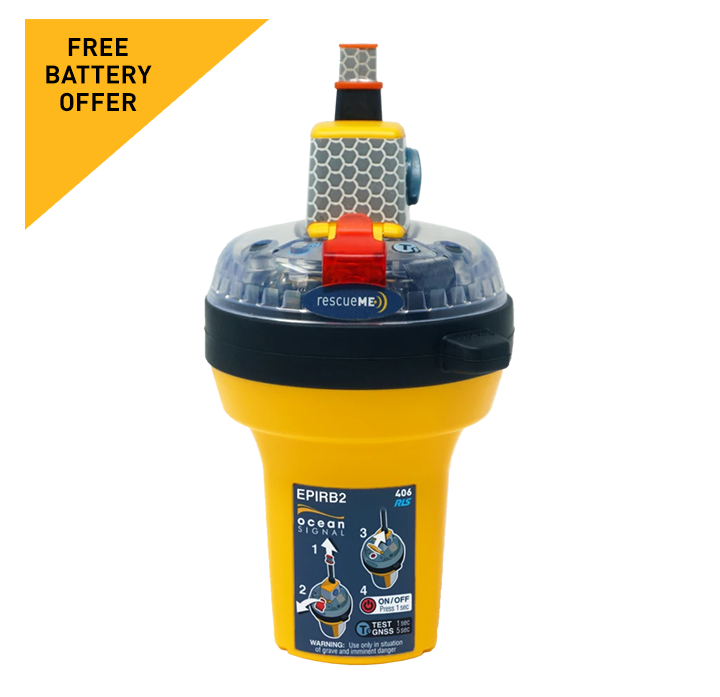
The Ocean Signal rescueME EPIRB2 is a Category II, manually released Emergency Position Indicating Radio Beacon for boats. It combines global 406 MHz Cospas-Sarsat satellite distress alerting, GNSS positioning and Return Link Service (RLS) acknowledgement. You can program your vessel’s MMSI in minutes using the Ocean Signal User Programming Kit and app.

Category II manual release. No AIS transmission. RLS availability depends on country configuration.
Return Link Service · blue-light acknowledgement
See that your call for help got through.

A visible acknowledgement. At your beacon.
RLS sends an acknowledgement back through Galileo satellites. When EPIRB2 receives it, the blue RLS acknowledgement pattern confirms that the Cospas-Sarsat system has received and located your distress alert.
When you are waiting for assistance, that confirmation answers one important question: did the alert reach the satellite rescue system?
RLS confirms receipt and localisation of the alert. It does not confirm that a rescue mission has launched or give an arrival time.
Read the manual to recognise the acknowledgement pattern. RLS is dependent on the beacon’s country configuration.
User programming · your vessel, your MMSI
Connect. Customise. GO
Set up in minutes using your smartphone. No dealer visit. No posting your beacon away.
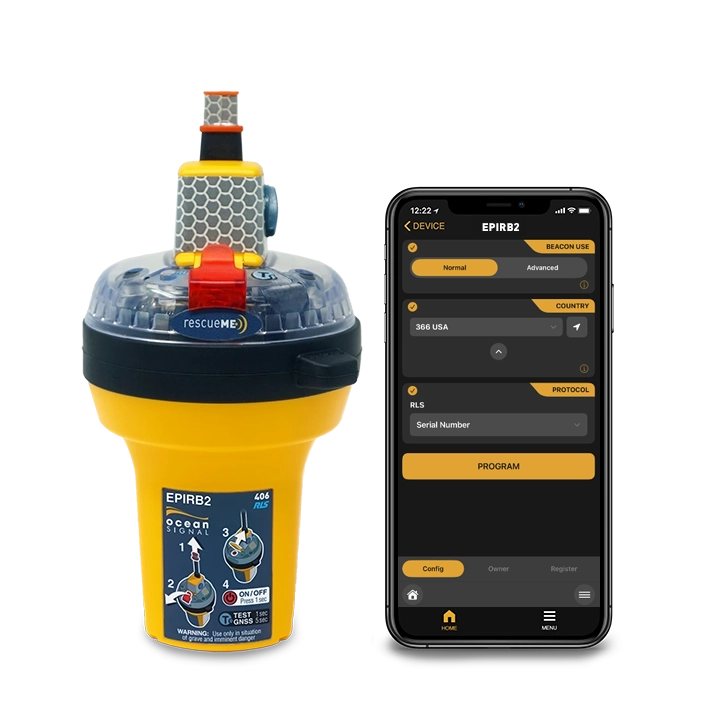
Done in minutes.
Use the Ocean Signal User Programming Kit, a compatible smartphone and the Ocean Signal app to program your EPIRB2 with your vessel’s MMSI in minutes.
At home. On your schedule.
No trip to a programming centre and no posting your beacon away. Do it yourself from home and avoid dealer programming fees and postage costs.
Enter your details. Check them. Register.
Have your vessel’s assigned nine-digit MMSI (Maritime Mobile Service Identity) ready. Use the supported country configuration and follow the kit instructions to save and verify the beacon’s programmed details.
Programming and registration are separate. After programming, complete or update the beacon’s registration using its verified HEX ID/UIN.
Requires the Ocean Signal User Programming Kit and a compatible smartphone. Follow the kit guidance for supported country settings and registration.
Built for the boat, ready for the unexpected
When a voyage becomes an emergency.
Flooding. A dismasting. A medical emergency offshore. When you need outside assistance, a dedicated satellite distress beacon gives you another way to raise the alarm.
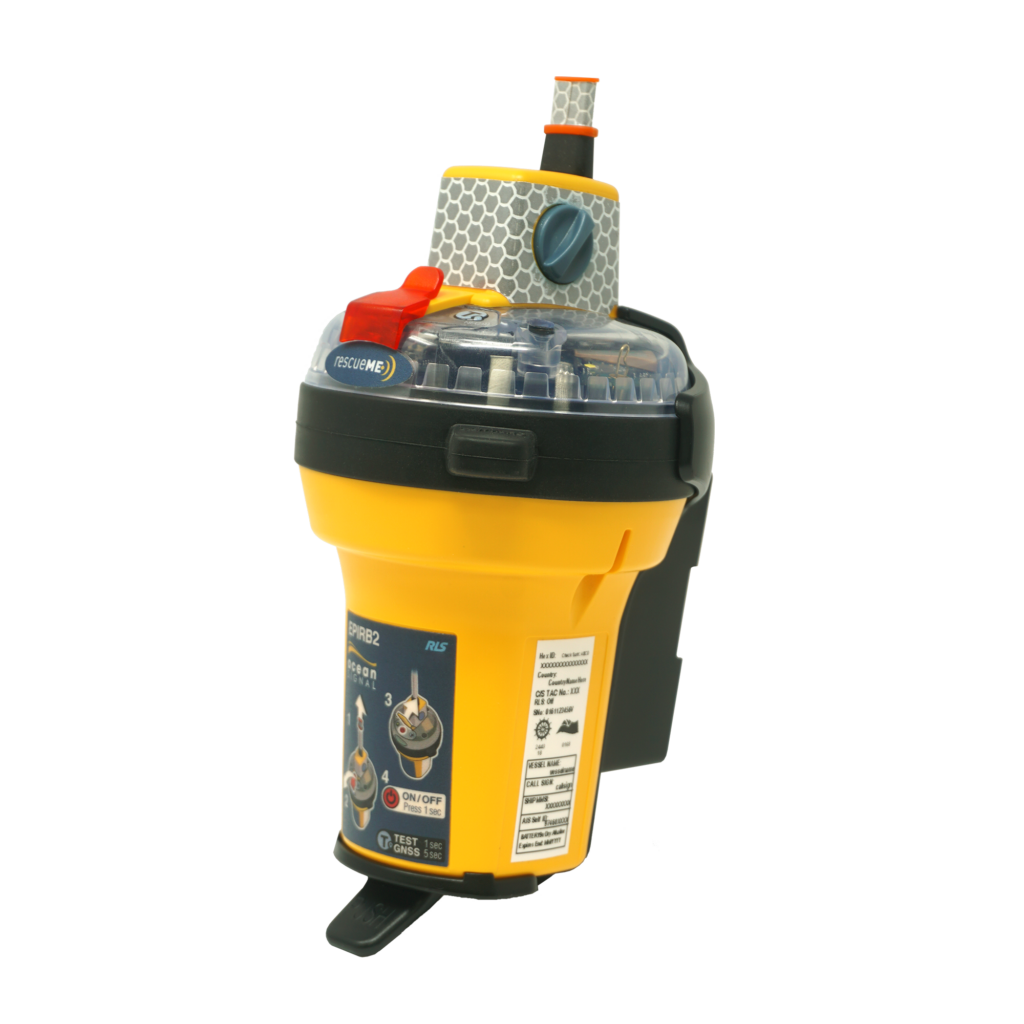
A dedicated call for Search & Rescue.
EPIRB2 uses its own battery and satellite distress radio, so sending an alert does not depend on a mobile signal, a smartphone or the boat’s electrical supply.
Position information, sent with your alert.
Its integrated GNSS (Global Navigation Satellite System) receiver uses GPS, Galileo and GLONASS to establish a position. That location is included in the 406 MHz distress message once a fix is available.
Signals that support the final approach.
A 121.5 MHz homing signal, visible strobe and infrared strobe help suitably equipped rescuers locate the beacon.
From activation to Search & Rescue
How rescueME EPIRB2 sends a distress alert.
01
Establish your position.
After deployment and activation, the built-in GNSS receiver works to acquire your location. Keep the antenna fully extended with a clear view of the sky.
02
Send a satellite distress alert.
Satellites detect the 406 MHz transmission. Ground stations and Mission Control Centres process the alert and route it towards the responsible rescue authority.
03
Support the search and recovery.
Your beacon identity and position support rescue coordination. The homing signal and strobes provide additional ways for equipped responders to find the beacon.
Know your beacon before you need it
Manual release. Straightforward preparation.

Mount it where your crew can reach it.
The supplied quick-release bracket keeps EPIRB2 secured on board. Choose an accessible mounting location and show everyone where it is before departure.
Release, deploy and activate.
EPIRB2 must be removed from its Category II bracket by hand. Fully extend the antenna and follow the manual for deployment and activation. The Class 2 version supports water activation after removal from its bracket, as well as manual activation.
The supplied bracket does not release automatically if the boat sinks. For automatic float-free deployment, consider EPIRB2 Pro.
This is a product overview, not the operating procedure. Follow the supplied manual for the exact variant. Class 3 versions are manual activation only.
NFC smartphone connectivity
Check your beacon before you cast off.

Hold your phone close. See your beacon’s history.
Use a compatible NFC-enabled smartphone and the free Ocean Signal Product App to access stored beacon information at close range.
Review the checks you have completed.
Read recorded self-tests and GNSS tests, including available position-fix information and battery-use data. Use the app alongside the manual’s inspection and testing routine.
Your phone is not required to send a distress alert. NFC is not live tracking, remote activation or two-way messaging.
A dedicated emergency beacon
No subscription fees. Ever.

No monthly airtime plan.
EPIRB2 uses the Cospas-Sarsat distress-alerting system without a satellite subscription.
48+ hours when activated.
Specified emergency operating life is more than 48 hours at −20°C, subject to battery condition and correct use.
A 10-year battery interval.
Follow the expiry label and testing guidance. Arrange authorised battery replacement after emergency activation or when required by the manual.
Battery replacement, servicing and other ownership costs are separate from subscription-free satellite alerting.
The choice that matters
EPIRB2, EPIRB3 or EPIRB2 Pro?
For coastal cruising, offshore sailing, fishing and motorboating, choose the alerting capability and release system your vessel needs.
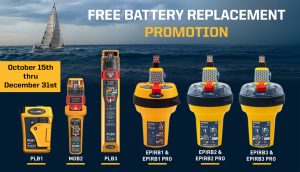
Choose EPIRB2 for satellite distress alerting, RLS and user MMSI programming with manual release. Choose EPIRB3 if you also want local AIS transmission, or EPIRB2 Pro for automatic float-free release.
| Your decision | EPIRB2 | EPIRB3 | EPIRB2 Pro |
|---|---|---|---|
| Global 406 MHz satellite distress alerting | Yes | Yes | Yes |
| RLS acknowledgement & NFC | Yes, country configuration applies | Yes, country configuration applies | Yes, country configuration applies |
| Local AIS transmission | No | Yes | No |
| Supplied release system | Category II · manual release | Category II · manual release | Category I · automatic float-free release |
| Choose it for | Satellite distress alerting with a manually released beacon. | Satellite distress alerting plus local AIS visibility to equipped vessels. | Satellite distress alerting with automatic float-free deployment. |
| Explore the model | You are viewing EPIRB2 | View EPIRB3 → | View EPIRB2 Pro → |
Need both AIS and automatic release? Explore safeSEA EPIRB3 Pro →
An EPIRB is carried for the vessel. A PLB adds a beacon that can stay with an individual crew member. Explore rescueME PLB3 →
Check your vessel’s flag, use and operating-area requirements before buying. If AIS, automatic float-free release or specific approvals are required, choose a model that meets those requirements.
Real-world EPIRB rescue evidence
A flooded boat. Four sailors in a life raft.

Sailing · John & David
After their yacht struck submerged rocks, water entered faster than the crew could remove it. Four sailors abandoned the boat into a life raft, taking their Ocean Signal EPIRB1 with them.
They activated the beacon. A U.S. Coast Guard aircraft and nearby vessels became part of the rescue that brought all four crew members to safety.
“When it really must work… it really does work!”
John & David, Ocean Signal survivor story.
This account involved an EPIRB1, not an EPIRB2. It illustrates the role of a vessel-carried EPIRB in a real emergency; it is not a promise of a particular response time or outcome.

The 406 Survivor Club
Use your Ocean Signal PLB or EPIRB in a genuine lifesaving emergency, share your rescue story and apply for a free replacement beacon. Programme eligibility and verification apply.
EPIRB2 Sailing Safety Kit
Build the rest of your grab bag.

Start with EPIRB2. Keep the essentials together.
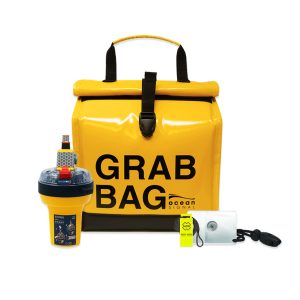
The EPIRB2 Sailing Safety Kit pairs the beacon with an Ocean Signal waterproof grab bag, an ACR signal mirror and a whistle. It is a practical option when you are putting together your emergency equipment.
See kit contents and current price →
Check the kit page for current contents, availability and price.
Ocean Signal customer feedback
Trusted by Ocean Signal customers
Read customer reviews covering Ocean Signal products and service. This is the company-wide review feed, rather than an EPIRB2-only rating.
Product details & support
rescueME EPIRB2 specifications & documents.
| Specification | rescueME EPIRB2 |
|---|---|
| Product type | Emergency Position Indicating Radio Beacon (EPIRB) |
| Satellite distress transmission | 406.031 MHz · Cospas-Sarsat |
| Local homing transmission | 121.5 MHz |
| Positioning | 72-channel GNSS receiver · GPS, Galileo and GLONASS |
| Return Link Service | RLS capable · availability depends on country configuration |
| User programming | Vessel MMSI programming using the Ocean Signal User Programming Kit and app; supported country settings apply |
| Smartphone connectivity | NFC · compatible smartphone and Ocean Signal Product App |
| Strobes | Visible white and infrared |
| Emergency operating life | More than 48 hours at −20°C, subject to battery condition |
| Battery replacement interval | 10 years; follow expiry label and replace after activation as directed |
| Deployment | Category II · manual release bracket |
| Activation | Class 2: manual, or water activation after bracket removal. Class 3: manual only. |
| Warranty | 2 years standard; eligible products can extend to 5 years by registering with Ocean Signal within 90 days, subject to terms. |
Included with EPIRB2
- rescueME EPIRB2
- Manual mounting bracket
- User guide and labels
- Three mounting screws
Before your first voyage
Simple to own. Important to prepare.
Program your vessel’s MMSI.
Use the Ocean Signal User Programming Kit and app to enter your vessel’s assigned MMSI with the supported country configuration. Read back and verify the saved details as the kit instructions direct.
Register the beacon.
Complete registration with the relevant national authority and keep vessel and emergency-contact details current. Warranty registration is a separate step.
Brief your crew.
Read the manual, mount the beacon where it is accessible and follow its testing schedule. Show your crew how to release and use it.
Choosing, preparing and using EPIRB2
Your rescueME EPIRB2 questions, answered.
Can I program EPIRB2 with my vessel’s MMSI myself?
Yes. Use the Ocean Signal User Programming Kit with a compatible smartphone and the Ocean Signal app to program your vessel’s MMSI in minutes. Follow the supported country settings and verify the saved details. Complete or update national beacon registration separately.
Does EPIRB2 work without a mobile signal?
Yes. Its 406 MHz distress radio communicates through Cospas-Sarsat satellites, independently of mobile networks. Correct deployment and a clear sky view remain important.
Does EPIRB2 have AIS?
No. EPIRB2 has satellite distress alerting and a 121.5 MHz homing signal, but no AIS transmitter. Choose EPIRB3 if you also want local AIS transmission.
Does EPIRB2 release automatically if the boat sinks?
No. Its supplied Category II bracket requires manual release. Water activation on the Class 2 version is a separate function that operates after bracket removal. EPIRB2 Pro includes automatic float-free release.
What does the blue RLS acknowledgement mean?
It confirms that the satellite rescue system has received and located the distress alert. It does not confirm rescue dispatch or an arrival time. Check the manual for the indicator pattern and your country configuration.
Do I need a subscription or a phone to send an alert?
Neither is needed for emergency satellite alerting. A compatible smartphone is used separately to access NFC beacon data and diagnostics.
Does programming my MMSI also register my EPIRB?
No. Programming writes the beacon’s configuration. Registration links its verified HEX ID/UIN to your owner, vessel and emergency-contact details with the relevant national authority. Find your national beacon registry and complete or update that record separately.
How long does the battery last?
The battery has a 10-year replacement interval and specified emergency operation of more than 48 hours at −20°C. Follow the expiry label, test limits and servicing instructions. The battery is not user-replaceable.
Do I need an EPIRB if my crew already carries PLBs?
They serve different carriage roles: an EPIRB is carried for the vessel, while a PLB can stay with an individual. Check your vessel’s requirements and consider both as part of your emergency plan.
Make it part of your plan before you leave port.
Global satellite distress alerting. Blue-light RLS acknowledgement. User MMSI programming in minutes. Choose EPIRB2 for a manually released beacon you can prepare for your own vessel.